Category: News

  • DBIZ Autonomous AI Agent Event — Ho Chi Minh City, 10 December 2025

    Blog

    ›

    Insights

    DBIZ Autonomous AI Agent Event — Ho Chi Minh City, 10 December 2025

    Introducing an AI agent ecosystem that runs inside the enterprise, for Vietnamese business

    By DBIZ

    –

    –

    4 min read

    Contents:

    Product detail:

    DBIZ Autonomous AI Agent Event

    On 10 December 2025 in Ho Chi Minh City, DBIZ held the DBIZ Autonomous AI Agent Event, bringing together business leaders, CIOs and CTOs, operations managers and IT specialists actively seeking answers to automating operations with AI at a time when technology costs and security requirements are both rising.

    The event did more than introduce a new technology solution; it reflected how DBIZ sees the future of the digital enterprise: AI should be operated as an internal capability, with data fully under the organisation’s control and value that is measurable in day-to-day operations.

    Why DBIZ introduced Autonomous in 2025

    DBIZ opened the event with a central question: why have so many enterprises invested in AI without producing clear value in operations?

    • The cost of deploying and running AI — particularly cloud AI — rises quickly with scale
    • A shortage of IT staff to maintain and extend the system
    • Security risk when internal data has to be sent to an external platform
    • Existing ERP, CRM and POS systems that are difficult to integrate new AI solutions with

    From this reality, DBIZ argues that enterprises need a different AI model: AI running on site (local AI), independent of external APIs, with no per-call cost, and — most importantly — with data always under the enterprise’s control. DBIZ Autonomous was developed on this thinking.
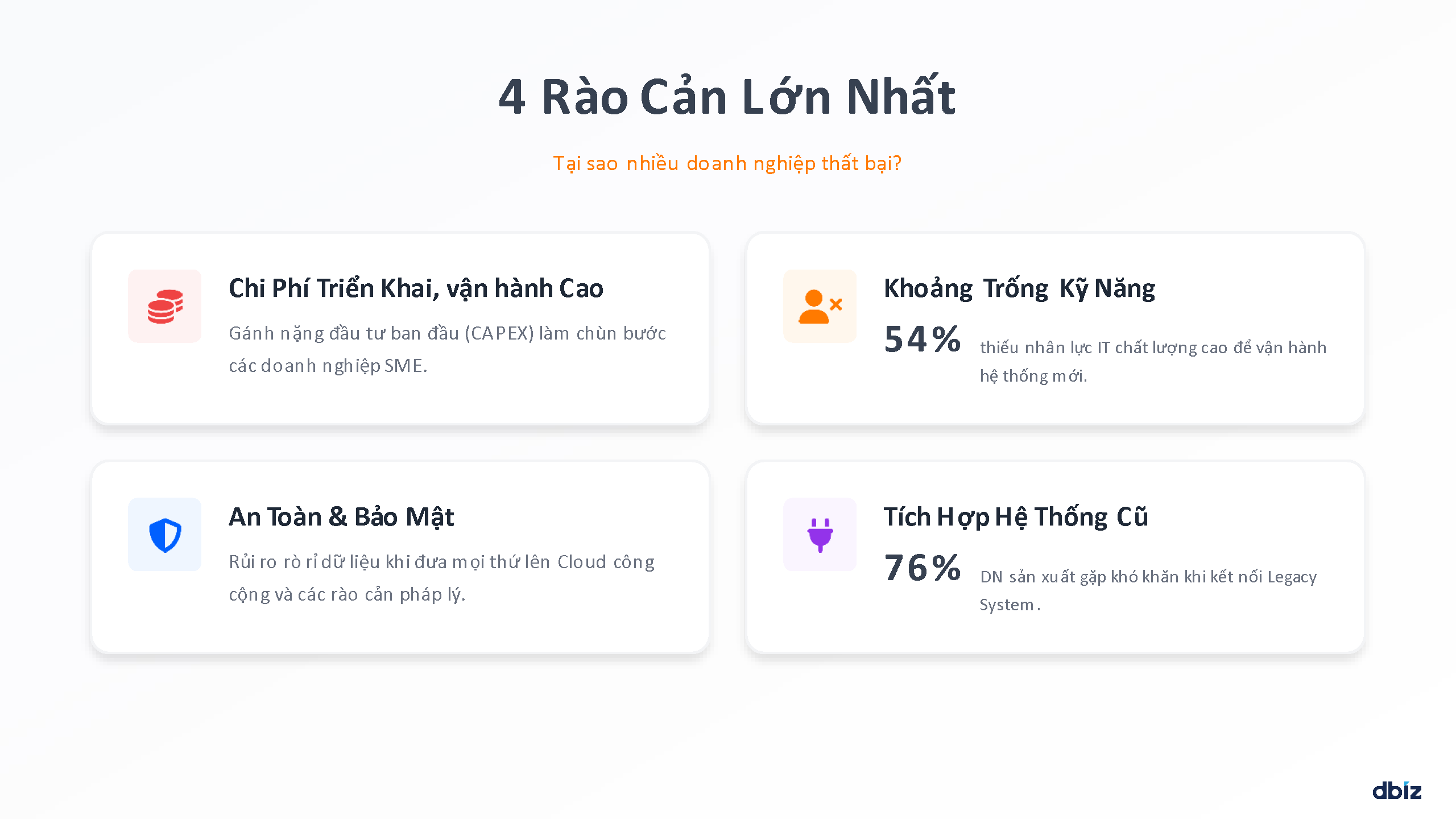
    The main barriers

    The questions the business community raised most often

    During the open discussion, many managers shared their practical concerns:

    • Can AI be integrated into our existing systems without disrupting operations?
    • What does a business need to prepare before deploying AI?
    • How is the ROI of an AI agent calculated?
    • Is local AI powerful enough to replace cloud AI?
    • Where should manufacturing, retail and financial services begin with AI?

    These questions point to a common need: AI must be practical and produce clear value, not remain a temporary experiment.

    For that reason, the DBIZ local AI model was seen as a fitting answer for businesses that need security, control and cost efficiency.

    DBIZ Autonomous — an AI agent ecosystem for real operations

    At the event, DBIZ introduced the DBIZ Autonomous ecosystem comprising specialist AI agents, developed to address the core problems in business operations directly. Each product focuses on a specific area — from forecasting, planning and production execution through to interaction, accounting and document processing — with the aim of helping enterprises deploy AI pragmatically, measure the results, and operate safely within their own environment.

    The ecosystem currently comprises five principal AI agent products: DBIZ Forecast, DBIZ APS, DBIZ MES, Chatbot AI and AP Invoice Processing, which can be deployed independently or together, according to each organisation’s needs and readiness.

    DBIZ Forecast

    DBIZ Forecast collects and standardises data from multiple sources (sales, inventory, production schedules, market data, consumer behaviour), applies a range of forecasting models (ARIMA, Prophet, VAR, linear regression, random forest and others) and compares their results to select the most suitable approach. The process runs in four steps: (1) data collection, (2) cleansing and standardisation, (3) running the forecast models, (4) reporting the results with recommended actions and what-if scenarios, alongside summary and detailed reports to support purchasing plans and supplier management. The documentation highlights its application in FMCG and its ability to select models according to data complexity.

    DBIZ APS (advanced planning & scheduling)

    DBIZ APS is an advanced production planning and scheduling solution using a hybrid AI engine (combining machine learning, constraint programming and heuristic search) to automate MPS and MRP and optimise scheduling. The key points:

    • Intelligent planning based on real-time data (machines, labour, orders, materials).
    • Re-optimisation the moment something changes (a machine failure, an urgent order).
    • The algorithms: priority calculation, capacity matching, greedy allocation and heuristic optimisation; MRP driven by machine learning for demand and lead-time forecasting.
    • The results presented: planning time reduced from days to hours, productivity up around 20–25% and planning time down 70%; plan accuracy above 90%.

    DBIZ APS also provides screens and flows for demand forecasting, production planning, MRP optimisation, supply planning and supplier management, and integrates closely with MES to keep planning and execution in step.

    DBIZ MES (manufacturing execution system)

    DBIZ MES is an intelligent production execution platform, capturing data from IoT devices and equipment, monitoring in real time, managing quality, providing traceability and optimising OEE. The highlights:

    • Live production monitoring, a real-time OEE dashboard, and drill-down to the individual machine.
    • AI vision for quality control; predictive maintenance to reduce downtime; work order tracking and a mobile MES for shop-floor use.
    • Deep integration with ERP and APS so that plan and execution stay synchronised; support for traceability, QR label printing and lot and batch management.
    • The benefits cited: reporting consolidation time down around 25%, actual productivity up around 15–20%, downtime down around 30%, and better decision-making.

    DBIZ MES is described as the nerve centre of the plant, turning operational data into immediate recommended actions.

    Chatbot AI

    Chatbot AI is a complete virtual assistant integrating a knowledge base with NLP to serve a range of scenarios: customer support, sales advisory (Sales AI), technical and HR assistance in the plant, and analytics dashboards. The principal features:

    • A central knowledge base updated in real time; support for uploading PDF, Word, Excel and PowerPoint files, website crawling, integration with OneDrive, Google Drive and SharePoint, and connection to CRM and ERP.
    • NLP: contextual understanding, multi-language support (Vietnamese and English), and continuous learning to improve accuracy.
    • Sales AI: 24/7 advisory, behavioural analysis, product recommendations and support in closing orders.
    • Permissions and security (AES-256, audit trail), analytics and visualisation (the chatbot generates charts and reports on request).

    Chatbot AI can be integrated directly into operational flows — for example, querying MES and APS data, and providing operating instructions and training material.

    AP Invoice Processing (OCR)

    The DBIZ automated invoice processing solution collects invoices from multiple sources (Outlook, Gmail, drag-and-drop upload), applies AI-based OCR combined with an LLM to extract the data, and integrates verification with the General Department of Taxation. The main process:

    • Multi-source collection → intelligent OCR → lookup and verification with the tax authority → checking and reconciliation (cross-checking PO, GR and invoice) → duplicate detection.
    • The system supports multiple formats (PDF, JPEG, PNG, TIFF) and batch processing; the OCR is described as achieving accuracy above 99%.
    • The business benefits cited: processing time down around 70% against manual work, accuracy around 99%, savings of around 50% in finance department operating cost, and full regulatory compliance.

    The solution also provides APIs for integration with SAP, Oracle, Misa and Bravo, and webhooks for real-time updates.

    Detailed product documentation:

    Solution demonstration and the technology beneath

    During the demonstration, DBIZ showed how the AI agents run on the DBIZ Autonomous Local AI Core, the AI platform that operates inside the enterprise.

    The principal technology components presented were:

    • Local LLMs (Llama, Mistral, DeepSeek)
    • A flexible microservices architecture
    • An API gateway integrating with SAP, Oracle, Misa, Bravo and Dynamics
    • Real-time visualisation within the chatbot
    • Enterprise-grade knowledge management
    • Next-generation OCR connected directly to the tax authority

    This approach allows an enterprise to deploy AI without depending on an external cloud AI platform.

    The DBIZ Autonomous roadmap — how a business takes ownership of AI step by step
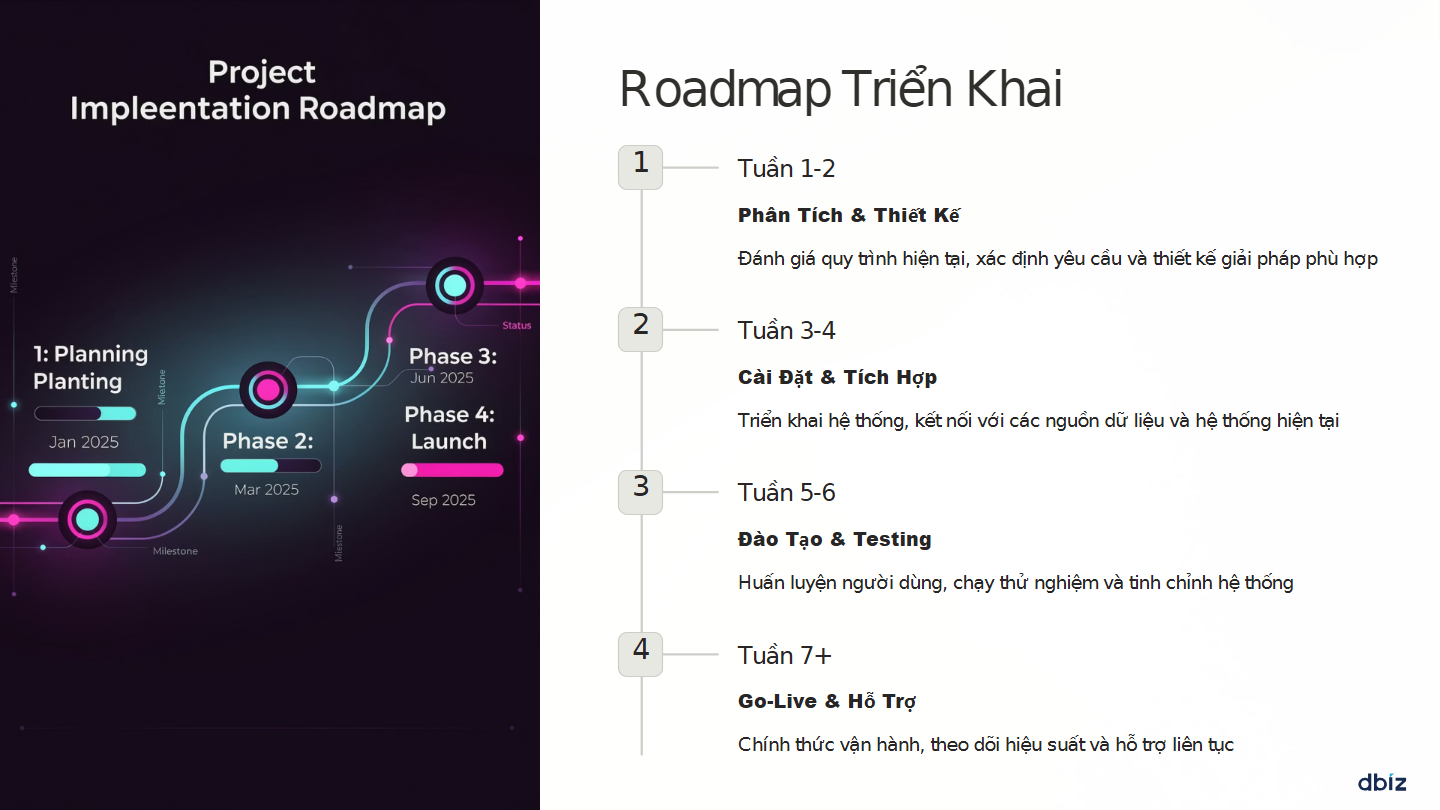
    Implementation roadmap

    At the event, DBIZ emphasised that deploying AI in an enterprise should not begin with the technologybut with the readiness of the systems, the data and the people. DBIZ Autonomous is therefore delivered on a standard roadmap that helps a business take ownership of AI step by step, in a state of control, transparency and measurable results.

    Phase 1 — Assessing current capability (weeks 1–2)

    The first phase focuses on understanding the organisation’s actual position before AI enters operations. The DBIZ team carries out a full assessment to identify the most suitable starting point.

    • System infrastructure: hardware, network, integration capability
    • Current processes: how far SOPs are standardised
    • Data: structure, cleanliness and usability
    • People: readiness for change and digital skills

    The outcome of this phase is a clear picture of readiness for AI deployment.

    Phase 2 — Building the strategy and KPIs (weeks 3–4)

    From the assessment, DBIZ works with the business to identify the most feasible AI use cases, prioritising those with a direct impact on operations and cost.

    • Selecting the right AI agents for each core process
    • Defining clear KPIs to measure the results
    • Designing a deployment architecture that fits the existing systems

    This phase helps the business avoid spreading AI too thinly and concentrate on real value.

    Phase 3 — Deploying the AI agents (weeks 5–6)

    Once the strategy is agreed, the DBIZ Autonomous Local AI Core is installed and integrated with the existing ERP, CRM and POS systems. The AI agents are fine-tuned on the organisation’s own data.

    • Installing the internal AI infrastructure
    • Connecting the data and business systems
    • Training users, running trials and calibrating

    AI enters operation progressively, under supervision and control.

    Phase 4 — Go-live and continuous optimisation (week 7 onward)

    Once the system is running stably, the AI agents are extended to further departments and processes. Results are monitored continuously to optimise and scale.

    • Formal go-live
    • Monitoring performance and KPIs
    • Extending the scope of automation as actual needs dictate

    Quantified return on investment

    According to the delivery figures DBIZ shared at the event:

    • Payback period: around six months
    • ROI after 12 months: +150%
    • ROI after 18 months: +300%

    This roadmap allows an enterprise to deploy AI under control, avoiding risk and optimising long-term return.

    In conclusion — the journey to digital self-reliance has formally begun

    The DBIZ Autonomous AI Agent Event of 10 December 2025 marked an important shift in how Vietnamese enterprises approach AI: with self-reliance, security and economic effectiveness.

    DBIZ believes the future of a business lies not in chasing technology trends but in its ability to own its AI platform and create long-term value from it.

    As a partner, DBIZ will continue to develop the Autonomous ecosystem, delivering AI solutions that are practical, durable and suited to each business model.
    Conclusion

    Request a demo and in-depth advice

    If your business is looking for:

    • AI-based process automation
    • Lower operating cost
    • A better customer experience
    • An independent AI platform

    DBIZ is ready to help.

    Email: [email protected]

    Hotline: 0904 153 409

    Website: dbiz.com

    DBIZ works alongside enterprises on the journey to self-reliance, efficiency and growth through AI.

    Share this article

    About the figures on this page

    The percentages above are industry reference levels — the range of impact international research bodies have recorded where organisations automate processes with AI: McKinsey Global Institute (2017) estimates that around half of today’s work activities are technically automatable; McKinsey & Company (2018) assesses that 42% of finance activities can be fully automated and a further 19% mostly automated with currently demonstrated technology; Brynjolfsson, Li & Raymond — NBER (2023) found a generative AI assistant raised customer-support productivity by 14% on average, and by 34% among newer staff. These are not measurements taken at any specific organisation and are not a performance commitment; actual results vary with deployment scope, data readiness and the current state of each organisation’s operations. Figures DBIZ has measured in the field are published separately together with the measurement method — see AP Agent — figures measured in the field. DBIZ commits to specific targets for each client after the assessment phase.

  • Working in the 5.0 era: a People × AI symbiosis strategy

    Industry 5.0 · Agentic AI · A new operating model

    People×AI
    A strategy for working symbiotically in the enterprise

    Industry 4.0 automated the machine. Industry 5.0 puts people back at the centre — not to compete with AI, but to direct teams of AI agents. The right strategy is not “who does AI replace” but a redistribution of decision rights: people keep what AI cannot yet do, and AI takes the rest.

    PEOPLE AI AGENTS SYMBIOSIS
    What people keep
    Direction · Judgement · Accountability

    Setting objectives, establishing values and risk appetite, deciding the exceptions, building relationships and trust, and bearing ultimate responsibility before the law and shareholders.

    What AI agents take on
    Collection · Analysis · Execution · Monitoring, around the clock

    Processing data and repetitive tasks at machine speed, running processes end to end, detecting anomalies in real time, and escalating to a person when an exception arises.

    The starting point

    Three gaps AI has not closed — and three strategic advantages for people

    Any symbiotic strategy must start with an honest acknowledgement of what AI cannot do today. These three gaps are the map for allocating roles in every function.

    GAP 01

    Worldview

    AI has no value system, no business ethics, no risk appetite and no sense of an organisation’s culture. It optimises the objective function it is given — it does not know which objective is right for the business in the long run.

    → The human role: setting the values
    GAP 02

    The whole picture

    AI sees only the data and context it is given. It does not perceive the connections across departments and legal entities, competitor moves, or market signals outside the data — the things leaders sense through experience.

    → The human role: connecting the system
    GAP 03

    Business logic

    The unwritten rules, the exceptions, the relationships with customers and suppliers — logic that appears in no document. AI learns the standard process, but a business runs on its exceptions too.

    → The human role: judging exceptions and training the AI
    The operating model

    The symbiotic loop: people set the intent, AI executes, people judge

    STEP 1 · PEOPLE

    Set the intent

    Define the objective, the constraints, the risk threshold and the criteria for success for the AI agent.

    STEP 2 · AI AGENT

    Execute & monitor

    Automate the process end to end, monitor around the clock, and handle the standard cases independently.

    STEP 3 · PEOPLE

    Judge the exceptions

    Intervene only when the agent escalates: an unusual case, high value, or legal risk.

    STEP 4 · BOTH

    Learn continuously

    Every human judgement becomes training data — business logic is progressively encoded.

    Principle 1: AI proposes — people decide (where the stakes are high) Principle 2: Touchless for standard cases, human-in-the-loop for exceptions Principle 3: Every employee becomes a manager of a team of agents
    Strategy by function

    Allocating People × AI across each department

    Each function reads against the same framework: people move up into a new role, AI agents take over the operational tasks, and the measure of success changes accordingly.

    ORCHESTRATOR AGENT BOARDFINMFGMKTSALESLOGPROCHR
    TARGET MODEL — AN ORCHESTRATOR COORDINATING BUSINESS AGENTS ACROSS DEPARTMENTS

    Board of management

    New KPI: speed and quality of decisions
    People
    • Holding the worldview: vision, values, risk appetite
    • Strategic decisions, M&A, capital allocation
    • Legal accountability and governance across legal entities
    AI agents
    • Strategy Copilot: daily synthesis of market and competitor activity
    • What-if scenario simulation across group-wide data
    • Early warning on financial, operational and compliance risk

    Finance & accounting

    New KPI: days to close, % touchless journal entries
    People
    • Judging exceptions, tax optimisation, capital structure
    • Relationships with banks, auditors and the tax authority
    • Strategic financial analysis for the board
    AI agents
    • Automated posting, reconciliation and three-way PO–GR–invoice matching
    • Period close and consolidation across legal entities
    • Cash-flow forecasting and real-time fraud detection

    Manufacturing

    New KPI: OEE, unplanned downtime
    People
    • Continuous improvement (Kaizen) and workplace safety
    • Decisions on equipment investment and technology change
    • Resolving complex incidents that require shop-floor experience
    AI agents
    • Production scheduling (APS) balancing capacity automatically
    • Predictive maintenance from IoT sensor data
    • Quality control with vision AI on the line

    Marketing

    New KPI: CAC, campaign launch speed
    People
    • Brand positioning, narrative, and local cultural insight
    • Major decisions on budget and brand portfolio
    • Approving sensitive content and protecting the group’s reputation
    AI agents
    • Multi-channel content production, personalised by segment
    • Real-time optimisation of advertising spend
    • Behavioural analysis, trend forecasting and social listening

    Sales

    New KPI: win rate, lead response time
    People
    • Building relationships and trust, negotiating high-value deals
    • Understanding each customer’s unwritten business logic
    • Decisions on pricing policy and exceptional discounts
    AI agents
    • SDR agent: prospecting, scoring and nurturing leads around the clock
    • Drafting quotations and contracts from templates; the CRM updates itself
    • Next-best-action recommendations for every opportunity

    Warehousing & logistics

    New KPI: on-time in-full (OTIF), inventory turnover
    People
    • Resolving delivery chain incidents, negotiating with carriers
    • Decisions on opening or closing warehouses and designing the distribution network
    • Setting priorities when resources conflict
    AI agents
    • Real-time route and load optimisation
    • Demand forecasting with automatic reorder point proposals
    • WMS agent: automated coordination of receipt, issue and stocktaking

    Supply & procurement

    New KPI: consolidation savings, PR→PO cycle time
    People
    • Strategic negotiation and relationships with key suppliers
    • Approval under the delegation matrix, new suppliers, high value
    • Make-or-buy decisions and category strategy
    AI agents
    • Sourcing agent: consolidating demand across entities, comparing RFQs
    • Compliance agent: blacklist and conflict-of-interest checks
    • Automatic PO generation, delivery tracking and payment reconciliation

    Human resources

    New KPI: time-to-hire, talent retention rate
    People
    • Shaping culture, developing leaders, building engagement
    • Sensitive decisions: promotion, discipline, restructuring
    • Redesigning work for the People × AI era
    AI agents
    • CV screening, initial interviews and automatic scheduling
    • Onboarding agent and a 24/7 internal policy assistant
    • Engagement analysis, attrition risk alerts and automated C&B
    The transformation roadmap

    Three stages: from assistant to symbiosis

    STAGE 1 · 0–6 MONTHS

    Copilot

    AI supports each individual: drafting, analysing, summarising. People make every decision. The objective: build AI literacy across the organisation and standardise the master data.

    STAGE 2 · 6–18 MONTHS

    Colleague (supervised agents)

    Agents run standard processes within each function, with people approving at the significant thresholds. Pilot in one or two departments with clear ROI (procurement, finance) and then extend.

    STAGE 3 · 18–36 MONTHS

    Symbiosis (self-operating agent teams)

    Agents coordinate across departments through an orchestrator; people manage by exception and concentrate on strategy, relationships and innovation.

    Human capability for the new era

    Four capabilities every employee needs

    AI literacy

    Understanding what AI can and cannot do, knowing how to delegate to an agent properly, and being able to assess the output.

    Managing a team of agents

    Setting objectives and constraints and supervising agents — a new management skill in place of manual operation.

    Data and systems thinking

    Seeing across departments, reading the whole picture that AI cannot see for itself, and connecting the links.

    Judgement and ethics

    Deciding in the grey areas, holding the worldview and the organisation’s ultimate accountability.

    The central message: AI will not replace people — but people who know how to direct AI will replace those who do not. The winning strategy in Industry 5.0 is to move the whole organisation from “performing tasks” to “setting direction, exercising judgement and training teams of AI agents” — where worldview, the whole picture and business logic become three competitive assets that cannot be copied.

    DBIZ · Agentic AI advisory & delivery
    www.dbiz.com
  • DBIZ delivers and successfully commissions the CRM system for the Viglacera Tien Son retail network

    Customer story · Viglacera Tien Son

    DBIZ delivers and successfully commissions the CRM system for the Viglacera Tien Son retail network

    DBIZ Digital Business Platform Joint Stock Company has formally completed and commissioned the CRM (customer relationship management) project for the retail network of Viglacera Tien Son, the company behind the Eurotile brand. The system went live on 17 May 2026 and, within a short period, has already recorded more than 1,000 orders, close to VND 40 billion in revenue, and over 600 dealers and architects onboarded.


    A multi-tier retail network in need of a shared backbone

    Viglacera Tien Son — part of the Viglacera Corporation, Vietnam’s leading manufacturer of wall and floor tiles, behind the Eurotile brand — operates a multi-tier distribution network spanning tier-one dealers, tier-two dealers, architects and contractors. Each group orders differently and works to its own pricing policy and entitlements.

    The challenge was never selling the product; it was connecting the entire network onto a single unified platform: orders, discounts, loyalty points, commissions and customer data all reconciled, transparent and automated — rather than scattered across spreadsheets, messages and paperwork.

    Think of it as a retail chain: if every store keeps its records differently, the owner can never know precisely who is selling well, which customers are loyal, or which rebate remains unpaid. This is exactly what DBIZ addressed.

    The DBIZ solution: seven modules, two channels, one seamless experience

    DBIZ built Viglacera Tien Son a complete CRM running across two parallel channels — a mobile app called Eurotile Partner and a webshop ordering portal for dealers:

    • Eurotile Partner — the mobile sales app: a direct channel for tier-two dealers, architects and contractors to browse products, see the pricing that applies to their role, place orders and track them from their phone.
    • Webshop: an online ordering portal for dealers — creating purchase orders, viewing agreed price lists, and managing invoices and transaction history.
    • CDP dashboard (customer data platform): a 360° overview of customer behaviour, combining data from the app and the webshop and updating in near real time, so the sales and marketing teams can follow metrics, conversion funnels and best-selling products.
    • Loyalty — the membership programme: complete member lifecycle management: registration, automatic points accrual on orders, tier upgrades and downgrades, reward redemption, with secure OTP verification.
    • Incentive — sales commission: automatic commission calculation for the sales team by target, achievement rate, product group and grade.
    • Commissions — deferred dealer rebates: tiered rebate levels set against committed sales volumes, calculated automatically with reward vouchers issued at period end.
    • The CX administration system: the operations control centre — managing customers, catalogue, sales and communications, integrated with the FAST accounting software for data synchronisation.

    The essential point: every transaction is entered once and flows end to end from the app or webshop through points, rebates and commissions to reporting — with no duplicate entry and no discrepancies.

    Results since go-live

    The system has been live since 17/05/2026. Within just two months, the first figures already show a clear effect:

    1.000+
    orders through the platform
    ~VND 40 bn
    in revenue recorded
    600+
    dealers and architects onboarded

    These are not merely numbers: they are evidence that the distribution network has genuinely moved online, rather than a system being installed and then left unused.

    “What we were looking for was not a piece of software but a platform that would let the entire dealer network operate in a shared language. Within two months of go-live, more than 600 dealers and architects were placing orders through the system on their own initiative, and every discount and loyalty policy became transparent and immediate. DBIZ worked alongside us from understanding our model through to running it live, and the results speak for themselves.”

    — A representative of the Viglacera Tien Son board

    The value delivered to Viglacera Tien Son

    • Transparency with partners: rebates, reward points and entitlements are calculated automatically and openly — strengthening trust across the dealer network.
    • Decisions driven by data: the CDP dashboard gives the team a 360° view of customers and channels, in place of instinct.
    • Lean operations with fewer errors: automating the calculations that were most prone to error when done by hand.
    • Long-term customer engagement: loyalty turns a single transaction into a recurring relationship.

    What this says about DBIZ

    The Viglacera Tien Son project further demonstrates DBIZ’s capability in building “Make in Vietnam” digital business platforms for large enterprises: from understanding a particular distribution model, through designing a multi-module system, to delivering and successfully commissioning it.

    For DBIZ, digital transformation is not the digitalisation of isolated fragments but the connection of every business activity onto one unified platform — simple to use, transparent enough to trust, and deep enough to grow on.

    Contact DBIZ for advice on CRM and digital transformation for your business: https://dbiz.com
  • From 1997 to the digital factory: DBIZ delivers the full DBIZ Foundation platform for Leepak

    Customer story

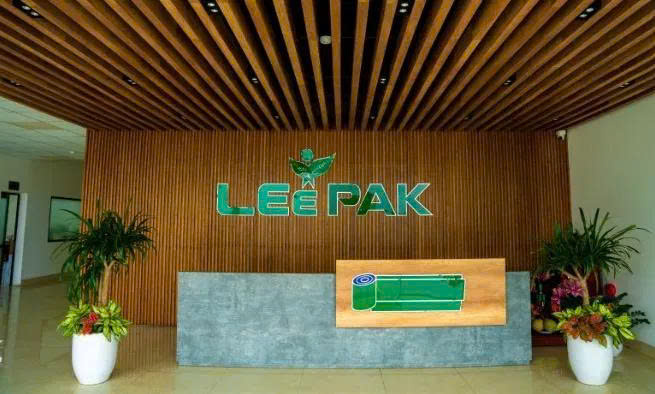
    From 1997 to the digital factory: DBIZ delivers the full DBIZ Foundation platform for Leepak

    Founded in 1997 and now in its third generation, Leepak is one of Vietnam’s leading exporters of plastic packaging, shipping some 40,000 tonnes of product to international markets each year. To make an operation of that scale accurate to the last figure, DBIZ Digital Business Platform Joint Stock Company deployed the DBIZ Foundation platform to unify procurement, production and warehousing, together with an AI agent that automates data entry.

    DBIZ delivers the DBIZ Foundation platform for Leepak

    Leepak — company profile

    1997
    founded, now in its third generation
    40,000 tonnes
    exported each year
    ~90%
    exported to the US, EU and Japan
    2 plants
    in Hanoi and Bac Ninh, with around 300 employees

    Leepak’s products range from shopping bags, food bags, zipper bags and refuse sacks to PE gloves and plastic film — serving retail chains and major partners worldwide. Its partners include names such as Lidl, Aldi and Edeka, alongside leading raw material suppliers including Dow and Borouge.

    The challenge: export-grade production, but data still keyed in several times over

    Before the deployment, Leepak tracked production and inventory manually with spreadsheets. Production staff recorded figures on paper by machine and by shift; a statistics clerk then consolidated them into an Excel file, and the data was keyed in once more to the system. Warehouse logs were kept separately for reconciliation.

    For a business sending 90% of its output to the US, EU and Japan, a discrepancy in the figures is not merely an internal inconvenience — it is a risk with the world’s most demanding customers on traceability and quality. The more times figures are transcribed across thousands of documents and hundreds of machines, the more likely actual output and system inventory diverge. The core problem was never “recording the numbers”; it was entering each transaction once and letting it flow end to end from production through warehousing to accounting.

    Operating scale on the system

    ~5,000+
    standardised item codes
    ~700
    suppliers in the master data
    40
    warehouses managed centrally
    100+
    mixing, blowing and cutting machines on the system
    ~650+
    production orders
    ~2,500
    purchase orders completed end to end
    ~10,000
    automated inventory journal entries
    ~1.5 years
    of continuous operation since late 2024

    The solution: a unified DBIZ Foundation platform with seamless modules

    DBIZ built Leepak a complete DBIZ Foundation platform, connecting previously separate functions into one continuous flow:

    • Procurement: end-to-end management from purchase order and goods receipt note through to purchase invoice — with close to 2,500 purchase orders and more than 2,500 goods receipt notes processed; item extraction from purchase orders and price control against agreed price lists are supported.
    • Accounts payable: a flow from payment request to payment document (cash voucher or payment order), supplier advances and allocation of advances against invoices on a FIFO (first in, first out) basis. Close to 800 payment requests have passed through this process.
    • Production: from production plan and work order through to Leepak’s three characteristic stages — mixing, blowing and cutting — recorded on stage tickets by machine and by shift: mixing resin and pigment, blowing HD/LD film rolls, then cutting, folding and sealing into roll bags, flat bags and T-shirt bags. More than 100 machines of various types have been standardised onto the system.
    • Warehousing: every movement of raw materials, finished and semi-finished goods and internal transfers passes through goods receipt and issue notes, replacing the separate warehouse log. From more than 200 receipt and issue notes, the system generates close to 10,000 inventory journal entries, giving an instant inventory picture across 40 warehouses.
    • Opening data setup: standardising and loading the opening data — customers, suppliers, item codes, inventory and receivables — so the system operated correctly from day one.
    Resin→Mixing→Blowing (film)→Cutting (bags)→Finished goods receipt→Export

    The essential point: each transaction is entered once and flows through production, warehousing and accounting — with no duplicate entry and no discrepancies between departments.

    The highlight: an AI agent automating data entry from Excel and email

    Rather than requiring staff to retype every line, DBIZ built an AI agent to act as an automated data-entry clerk:

    • It scans and reads input data from structured Excel files — the production log and the warehouse log.
    • It integrates with the company mailbox to receive report files and documents sent by email automatically.
    • It cleanses, maps and creates goods receipt and issue documents and stage tickets automatically, with no manual work — several hundred automated entry sessions have been processed.
    • There is a review screen: once the agent has processed the data, a user checks it as an approval step; only on approval does the system commit the documents.
    • Strict security standards are applied: encryption, access permissions and authentication protect the information.

    In short: the machine does the heavy, error-prone work — reading, gathering and matching figures — while people retain the final decision at the approval step.

    The value delivered to Leepak

    • A single source of data: production, warehousing and accounting all work from one system, ending the era of a separate file per department.
    • Export-grade transparency and traceability: every batch of bags is traceable from the mixing batch and blowing machine through to the cutting order — the foundation of trust with demanding international customers.
    • Less manual entry, fewer errors: automating the retyping steps that were most prone to error when done by hand.
    • Instant inventory transparency: output and inventory update the moment a document is approved, reflected in close to 10,000 automatically generated inventory entries.
    • Control is retained: the review and approval mechanism keeps the data automated without losing control.
    • Safe to extend: the standardised DBIZ Foundation platform allows further modules and processes to be added later without disrupting the system.

    Digital transformation is not the digitalisation of isolated fragments but the connection of every activity onto one unified platform — simple to use, transparent enough to trust, and deep enough to keep growing on.

    — The DBIZ delivery principle

    What this says about DBIZ

    For a brand 27 years old with 90% of its output exported, giving Leepak a digital foundation meant respecting the particular processes of the factory floor while raising data standards to an international level. The project further demonstrates DBIZ’s capability in building “Make in Vietnam” digital business platforms for manufacturers: from understanding the mixing–blowing–cutting process, through designing a multi-module system on DBIZ Foundation, to applying an AI agent to automate the heaviest data-entry work — helping Leepak continue to make an excellent first impression with every piece of packaging it sends into the world.

    Contact DBIZ for advice on DBIZ Foundation and digital transformation for your business:
    https://dbiz.com
  • DBIZ partners with PVOIL on comprehensive digital transformation across the petroleum sector

    Customer story · Oil & Gas

    DBIZ partners with PVOIL on comprehensive digital transformation across the petroleum sector

    DBIZ Digital Business Platform Joint Stock Company is the technology partner supporting PetroVietnam Oil Corporation (PVOIL) in digitalising all three of its sales channels — wholesale, retail and individual customers — through the PVOIL B2B, PVOIL Easy and PVOIL 4Uecosystem, covering the network of nearly 900 filling stations operated by PVOIL and COMECO nationwide.

    DBIZ digital transformation with PVOIL

    A petroleum major in need of a single operating platform

    PVOIL — a member of the Vietnam National Industry and Energy Group (Petrovietnam) — supplies more than 5.5 million m³/tonnes of fuel each year, some 22–25% of the domestic market, through industrial customers, close to 850 company-operated stations and nearly 1,800 dealer stations.

    PVOIL’s challenge was never selling the product; it was operating an immense network on a single unified platform: wholesale orders from dealers, deferred-payment transactions from transport fleets, and every individual refuelling — all reconciled for receivables, invoicing and data, rather than scattered across paper, cash and manual reconciliation.

    Consider the scale: every driver refuelling is a transaction, every dealer order is a contract, and every period-end brings thousands of reconciliations. Without a shared digital backbone, administrative cost grows with the network. This is precisely what DBIZ addressed.

    The DBIZ solution: three platforms, three sales channels, one seamless experience

    DBIZ worked with PVOIL to build a digital ecosystem covering all three sales channels — wholesale, retail and individual customers:

    PVOIL B2B

    The wholesale channel — dealers and industrial customers
    • Ordering, delivery and receivables on one system: wholesale customers (dealers and distributors) and industrial customers track the entire process of ordering, purchasing, delivery, receivables and payment through a mobile app or the web (b2b.pvoil.vn).
    • Nearly 2,000 customers were transacting through PVOIL B2B as at mid-2024.
    • E-invoicing on every sale: PVOIL has implemented e-invoice issuance for each individual sale, and the number of invoices issued per day has risen more than 450-fold.
    • Continuous enhancement: PVOIL continues to upgrade the PVOIL B2B system while building a central data warehouse and intelligent analytics reporting (DW+BI).

    PVOIL Easy

    The retail channel — transport companies and fleets
    • A pioneer in cashless QR payment in Vietnam’s petroleum sector since 2018: drivers scan a code, with no need for cash or a credit card.
    • Credit limits and deferred payment: a transport company signs once, refuels at any PVOIL station nationwide, and settles at period end.
    • Real-time fleet control: time, location, volume, vehicle and the limit applied to each transaction.
    • Integration with multiple payment channels: VCB, MoMo, ViettelPay, HDBank and GotIt.

    PVOIL 4U

    The individual customer channel — refuel now, pay later
    • An all-in-one app for individual customers (launched 30 September 2024): buy fuel at nearly 900 PVOIL and COMECO stations nationwide.
    • “Refuel now, pay later”: in partnership with HDBank, fuel purchase credit of up to VND 1 million per transaction, interest-free when repaid on time.
    • A broader set of services: gifting fuel vouchers, group transaction management, finding the nearest station, checking traffic penalty notices, and buying vehicle insurance.
    • E-invoices and transaction history are integrated directly into the app.

    The essential point: each transaction is recorded once and flows end to end — from the point of sale through receivables and e-invoicing to management reporting. No duplicate entry and no discrepancies, whether it is a dealer order of thousands of cubic metres or a VND 50,000 refuelling by an individual customer.

    The results

    The figures recorded across PVOIL’s digital ecosystem show a network that has genuinely moved online:

    ~2,400business customers using PVOIL Easy in 2024, up 10% on 2023 (source: PVN)
    400 m³/dayaverage volume through PVOIL Easy in 2024, up more than 16% on 2023 (source: PVN)
    14-foldgrowth in volume through PVOIL Easy over six years, now around 10% of retail volume (source: Tien Phong)
    ~2,000wholesale and industrial customers transacting through PVOIL B2B as at mid-2024 (source: PetroTimes)
    450-foldincrease in e-invoices issued per day once invoicing moved to a per-sale basis (source: PVN)
    ~900PVOIL and COMECO filling stations accepting transactions through PVOIL 4U (source: Vietnam Government Portal)
    PVOIL has identified digital transformation as a central, continuing priority — one of the three pillars of its development strategy, alongside the energy transition and diversification into non-fuel services.
    — From PVOIL’s official announcement (pvoil.com.vn)

    The value delivered to PVOIL

    • Transparency with customers and dealers: transactions, receivables, credit limits and invoices are recorded automatically and reconciled immediately, replacing error-prone manual credit records.
    • Cashless, in line with national policy: QR payment contributes to the Government’s direction on reducing cash usage in the economy.
    • Lean operations at scale: automation of ordering, delivery and per-sale invoicing means administrative cost does not grow with the network.
    • Long-term customer engagement: from credit limits for transport companies to “refuel now, pay later” for individual customers, each channel turns a single transaction into a recurring relationship.

    What this says about DBIZ

    The work with PVOIL further demonstrates DBIZ’s capability in building “Make in Vietnam” digital business platforms for organisations of group scale: from understanding the distribution model particular to the petroleum sector — corporation, regional business units, dealers, fleets and individual customers — through to designing a multi-module system and delivering and operating it reliably nationwide.

    For DBIZ, digital transformation is not the digitalisation of isolated fragments but the connection of every business activity onto one unified platform — simple to use, transparent enough to trust, and deep enough to grow on.

    Contact DBIZ for advice on digital transformation in the petroleum and retail sectors: https://dbiz.com

    Verified sources: PVN — pvn.vn (PVOIL Easy customer numbers and volumes 2024, e-invoicing); PetroTimes — petrovietnam.petrotimes.vn (PVOIL B2B customer numbers June 2024, B2B and DW+BI upgrade plans); Tien Phong — tienphong.vn, 30 September 2024 (market share, station numbers, 14-fold growth in Easy volume, launch of PVOIL 4U); Vietnam Government Portal — baochinhphu.vn (PVOIL Easy 2018, PVOIL 4U and HDBank); PVOIL — pvoil.com.vn (digital transformation strategy). The DBIZ–PVOIL partnership is stated in the customer references published at dbiz.com.