DBIZ Autonomous AI Agent Event — Ho Chi Minh City, 10 December 2025
Introducing an AI agent ecosystem that runs inside the enterprise, for Vietnamese business
By DBIZ
–
–
4 min read
Further material from the presentation
Contents:
Slides
Product detail:
DBIZ Forecast
DBIZ APS
DBIZ MES
Chatbot AI
AP Invoice Processing
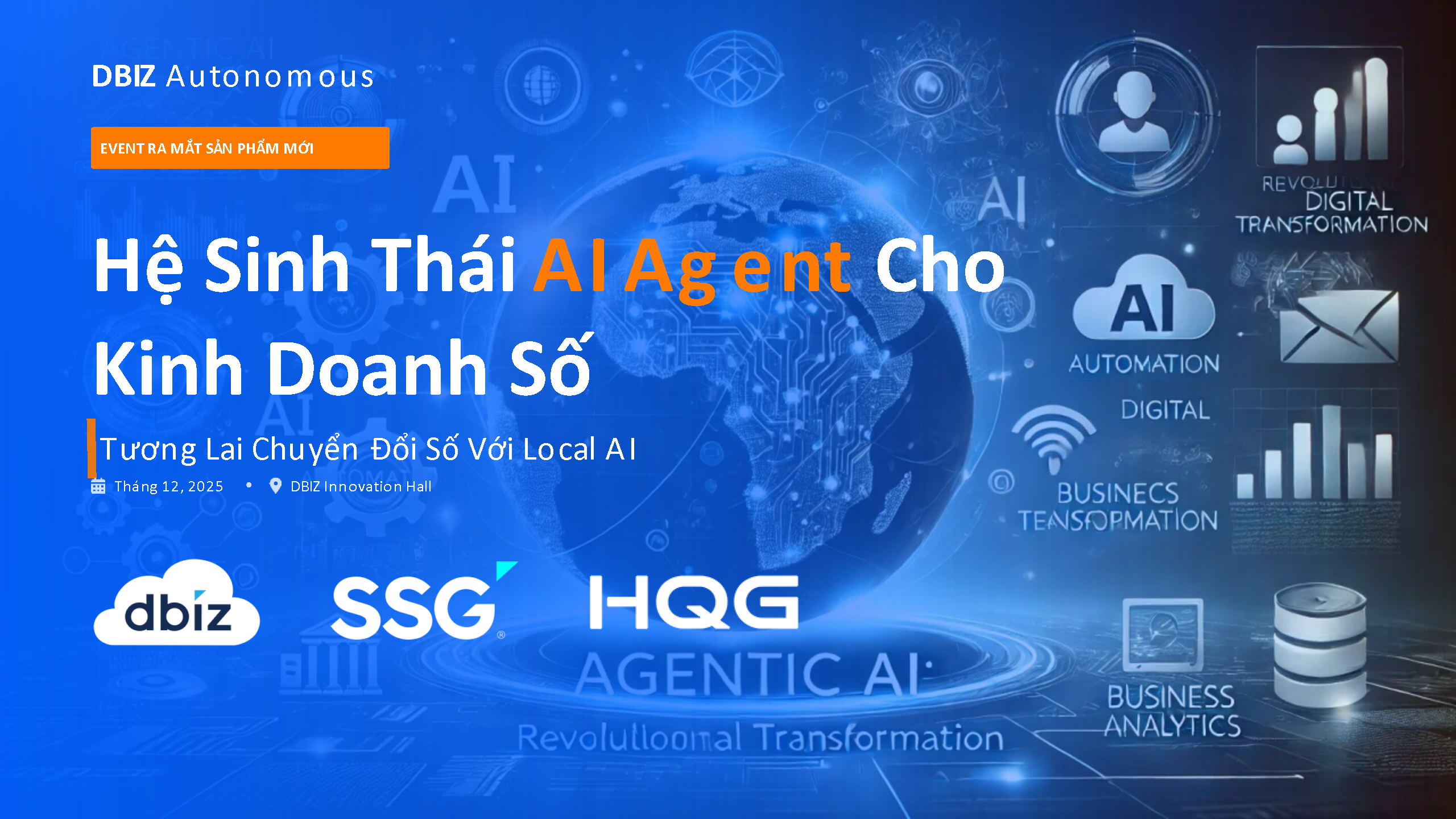
On 10 December 2025 in Ho Chi Minh City, DBIZ held the DBIZ Autonomous AI Agent Event, bringing together business leaders, CIOs and CTOs, operations managers and IT specialists actively seeking answers to automating operations with AI at a time when technology costs and security requirements are both rising.
The event did more than introduce a new technology solution; it reflected how DBIZ sees the future of the digital enterprise: AI should be operated as an internal capability, with data fully under the organisation’s control and value that is measurable in day-to-day operations.
Why DBIZ introduced Autonomous in 2025
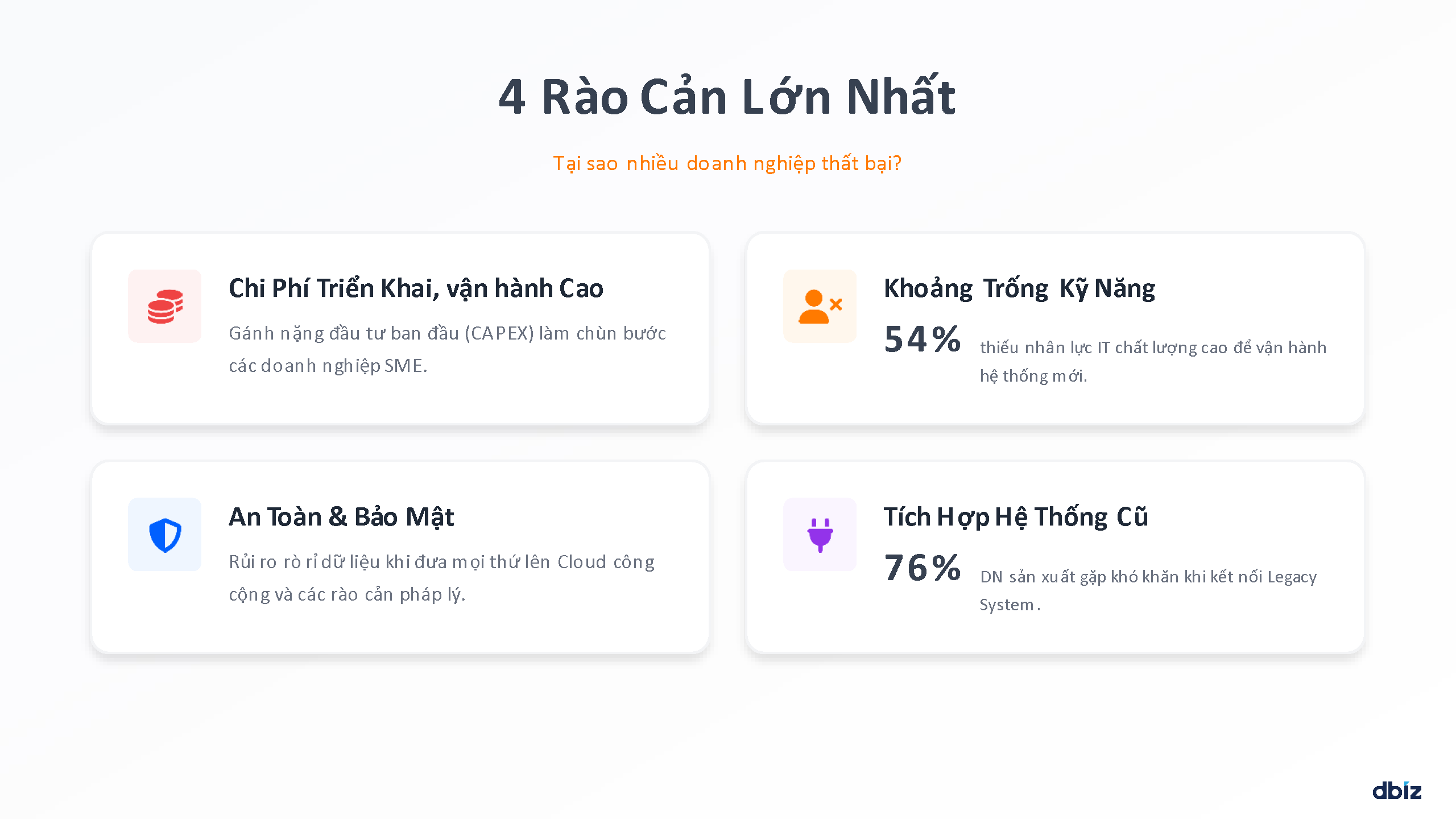
DBIZ opened the event with a central question: why have so many enterprises invested in AI without producing clear value in operations?
- The cost of deploying and running AI — particularly cloud AI — rises quickly with scale
- A shortage of IT staff to maintain and extend the system
- Security risk when internal data has to be sent to an external platform
- Existing ERP, CRM and POS systems that are difficult to integrate new AI solutions with
From this reality, DBIZ argues that enterprises need a different AI model: AI running on site (local AI), independent of external APIs, with no per-call cost, and — most importantly — with data always under the enterprise’s control. DBIZ Autonomous was developed on this thinking.
The questions the business community raised most often
During the open discussion, many managers shared their practical concerns:
- Can AI be integrated into our existing systems without disrupting operations?
- What does a business need to prepare before deploying AI?
- How is the ROI of an AI agent calculated?
- Is local AI powerful enough to replace cloud AI?
- Where should manufacturing, retail and financial services begin with AI?
These questions point to a common need: AI must be practical and produce clear value, not remain a temporary experiment.
For that reason, the DBIZ local AI model was seen as a fitting answer for businesses that need security, control and cost efficiency.
DBIZ Autonomous — an AI agent ecosystem for real operations
At the event, DBIZ introduced the DBIZ Autonomous ecosystem comprising specialist AI agents, developed to address the core problems in business operations directly. Each product focuses on a specific area — from forecasting, planning and production execution through to interaction, accounting and document processing — with the aim of helping enterprises deploy AI pragmatically, measure the results, and operate safely within their own environment.
The ecosystem currently comprises five principal AI agent products: DBIZ Forecast, DBIZ APS, DBIZ MES, Chatbot AI and AP Invoice Processing, which can be deployed independently or together, according to each organisation’s needs and readiness.
DBIZ Forecast
DBIZ Forecast collects and standardises data from multiple sources (sales, inventory, production schedules, market data, consumer behaviour), applies a range of forecasting models (ARIMA, Prophet, VAR, linear regression, random forest and others) and compares their results to select the most suitable approach. The process runs in four steps: (1) data collection, (2) cleansing and standardisation, (3) running the forecast models, (4) reporting the results with recommended actions and what-if scenarios, alongside summary and detailed reports to support purchasing plans and supplier management. The documentation highlights its application in FMCG and its ability to select models according to data complexity.
DBIZ APS (advanced planning & scheduling)
DBIZ APS is an advanced production planning and scheduling solution using a hybrid AI engine (combining machine learning, constraint programming and heuristic search) to automate MPS and MRP and optimise scheduling. The key points:
- Intelligent planning based on real-time data (machines, labour, orders, materials).
- Re-optimisation the moment something changes (a machine failure, an urgent order).
- The algorithms: priority calculation, capacity matching, greedy allocation and heuristic optimisation; MRP driven by machine learning for demand and lead-time forecasting.
- The results presented: planning time reduced from days to hours, productivity up around 20–25% and planning time down 70%; plan accuracy above 90%.
DBIZ APS also provides screens and flows for demand forecasting, production planning, MRP optimisation, supply planning and supplier management, and integrates closely with MES to keep planning and execution in step.
DBIZ MES (manufacturing execution system)
DBIZ MES is an intelligent production execution platform, capturing data from IoT devices and equipment, monitoring in real time, managing quality, providing traceability and optimising OEE. The highlights:
- Live production monitoring, a real-time OEE dashboard, and drill-down to the individual machine.
- AI vision for quality control; predictive maintenance to reduce downtime; work order tracking and a mobile MES for shop-floor use.
- Deep integration with ERP and APS so that plan and execution stay synchronised; support for traceability, QR label printing and lot and batch management.
- The benefits cited: reporting consolidation time down around 25%, actual productivity up around 15–20%, downtime down around 30%, and better decision-making.
DBIZ MES is described as the nerve centre of the plant, turning operational data into immediate recommended actions.
Chatbot AI
Chatbot AI is a complete virtual assistant integrating a knowledge base with NLP to serve a range of scenarios: customer support, sales advisory (Sales AI), technical and HR assistance in the plant, and analytics dashboards. The principal features:
- A central knowledge base updated in real time; support for uploading PDF, Word, Excel and PowerPoint files, website crawling, integration with OneDrive, Google Drive and SharePoint, and connection to CRM and ERP.
- NLP: contextual understanding, multi-language support (Vietnamese and English), and continuous learning to improve accuracy.
- Sales AI: 24/7 advisory, behavioural analysis, product recommendations and support in closing orders.
- Permissions and security (AES-256, audit trail), analytics and visualisation (the chatbot generates charts and reports on request).
Chatbot AI can be integrated directly into operational flows — for example, querying MES and APS data, and providing operating instructions and training material.
AP Invoice Processing (OCR)
The DBIZ automated invoice processing solution collects invoices from multiple sources (Outlook, Gmail, drag-and-drop upload), applies AI-based OCR combined with an LLM to extract the data, and integrates verification with the General Department of Taxation. The main process:
- Multi-source collection → intelligent OCR → lookup and verification with the tax authority → checking and reconciliation (cross-checking PO, GR and invoice) → duplicate detection.
- The system supports multiple formats (PDF, JPEG, PNG, TIFF) and batch processing; the OCR is described as achieving accuracy above 99%.
- The business benefits cited: processing time down around 70% against manual work, accuracy around 99%, savings of around 50% in finance department operating cost, and full regulatory compliance.
The solution also provides APIs for integration with SAP, Oracle, Misa and Bravo, and webhooks for real-time updates.
Detailed product documentation:
DBIZ Forecast
DBIZ APS
DBIZ MES
Chatbot AI
AP Invoice Processing
Solution demonstration and the technology beneath
During the demonstration, DBIZ showed how the AI agents run on the DBIZ Autonomous Local AI Core, the AI platform that operates inside the enterprise.
The principal technology components presented were:
- Local LLMs (Llama, Mistral, DeepSeek)
- A flexible microservices architecture
- An API gateway integrating with SAP, Oracle, Misa, Bravo and Dynamics
- Real-time visualisation within the chatbot
- Enterprise-grade knowledge management
- Next-generation OCR connected directly to the tax authority
This approach allows an enterprise to deploy AI without depending on an external cloud AI platform.
The DBIZ Autonomous roadmap — how a business takes ownership of AI step by step
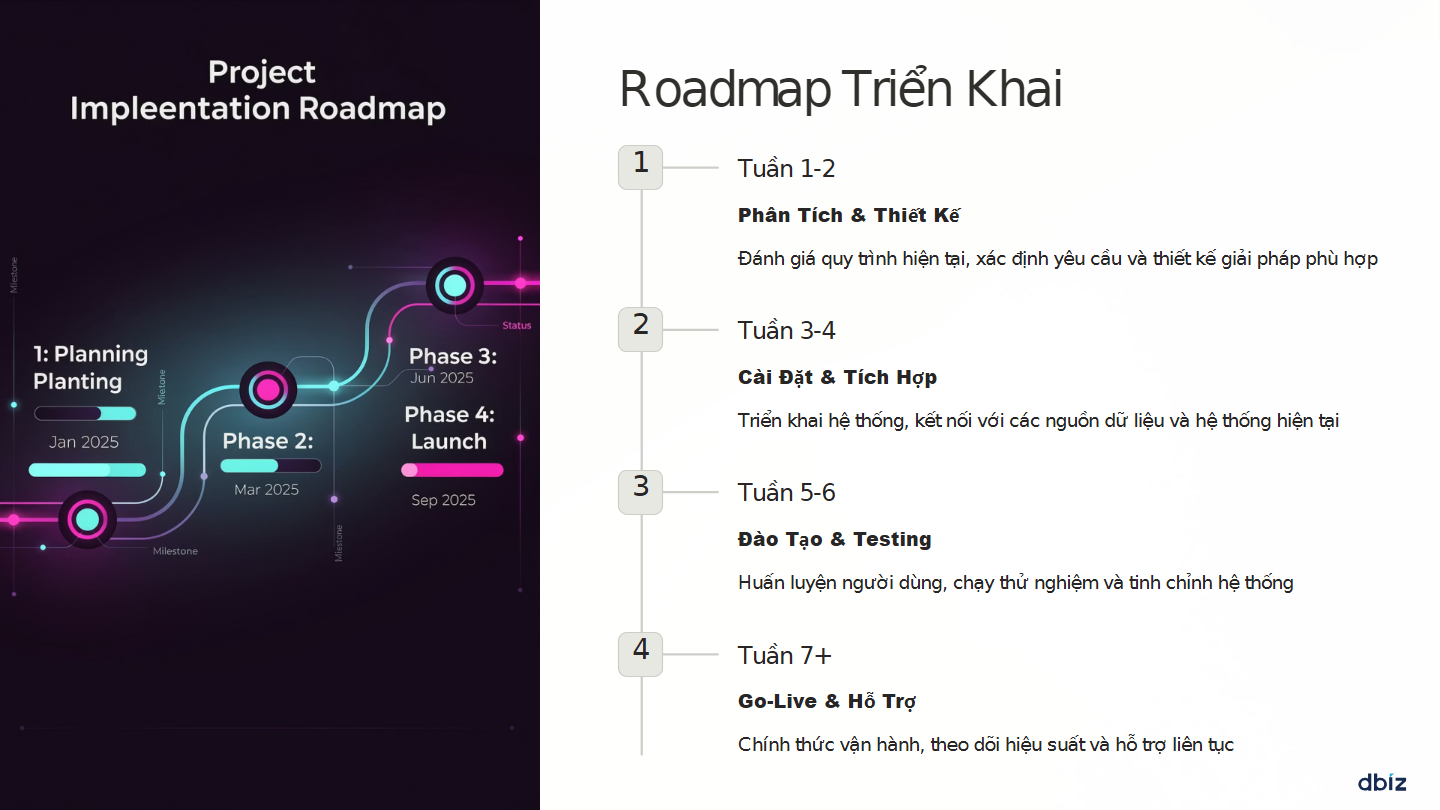
At the event, DBIZ emphasised that deploying AI in an enterprise should not begin with the technologybut with the readiness of the systems, the data and the people. DBIZ Autonomous is therefore delivered on a standard roadmap that helps a business take ownership of AI step by step, in a state of control, transparency and measurable results.
Phase 1 — Assessing current capability (weeks 1–2)
The first phase focuses on understanding the organisation’s actual position before AI enters operations. The DBIZ team carries out a full assessment to identify the most suitable starting point.
- System infrastructure: hardware, network, integration capability
- Current processes: how far SOPs are standardised
- Data: structure, cleanliness and usability
- People: readiness for change and digital skills
The outcome of this phase is a clear picture of readiness for AI deployment.
Phase 2 — Building the strategy and KPIs (weeks 3–4)
From the assessment, DBIZ works with the business to identify the most feasible AI use cases, prioritising those with a direct impact on operations and cost.
- Selecting the right AI agents for each core process
- Defining clear KPIs to measure the results
- Designing a deployment architecture that fits the existing systems
This phase helps the business avoid spreading AI too thinly and concentrate on real value.
Phase 3 — Deploying the AI agents (weeks 5–6)
Once the strategy is agreed, the DBIZ Autonomous Local AI Core is installed and integrated with the existing ERP, CRM and POS systems. The AI agents are fine-tuned on the organisation’s own data.
- Installing the internal AI infrastructure
- Connecting the data and business systems
- Training users, running trials and calibrating
AI enters operation progressively, under supervision and control.
Phase 4 — Go-live and continuous optimisation (week 7 onward)
Once the system is running stably, the AI agents are extended to further departments and processes. Results are monitored continuously to optimise and scale.
- Formal go-live
- Monitoring performance and KPIs
- Extending the scope of automation as actual needs dictate
Quantified return on investment
According to the delivery figures DBIZ shared at the event:
- Payback period: around six months
- ROI after 12 months: +150%
- ROI after 18 months: +300%
This roadmap allows an enterprise to deploy AI under control, avoiding risk and optimising long-term return.
In conclusion — the journey to digital self-reliance has formally begun
The DBIZ Autonomous AI Agent Event of 10 December 2025 marked an important shift in how Vietnamese enterprises approach AI: with self-reliance, security and economic effectiveness.
DBIZ believes the future of a business lies not in chasing technology trends but in its ability to own its AI platform and create long-term value from it.
As a partner, DBIZ will continue to develop the Autonomous ecosystem, delivering AI solutions that are practical, durable and suited to each business model.
Request a demo and in-depth advice
If your business is looking for:
- AI-based process automation
- Lower operating cost
- A better customer experience
- An independent AI platform
DBIZ is ready to help.
DBIZ works alongside enterprises on the journey to self-reliance, efficiency and growth through AI.
Share this article
About the figures on this page
The percentages above are industry reference levels — the range of impact international research bodies have recorded where organisations automate processes with AI: McKinsey Global Institute (2017) estimates that around half of today’s work activities are technically automatable; McKinsey & Company (2018) assesses that 42% of finance activities can be fully automated and a further 19% mostly automated with currently demonstrated technology; Brynjolfsson, Li & Raymond — NBER (2023) found a generative AI assistant raised customer-support productivity by 14% on average, and by 34% among newer staff. These are not measurements taken at any specific organisation and are not a performance commitment; actual results vary with deployment scope, data readiness and the current state of each organisation’s operations. Figures DBIZ has measured in the field are published separately together with the measurement method — see AP Agent — figures measured in the field. DBIZ commits to specific targets for each client after the assessment phase.