Luật Trí tuệ nhân tạo: Việt Nam phân loại AI theo rủi ro, doanh nghiệp triển khai cần chuẩn bị gì
Luật số 134/2025/QH15 đưa Việt Nam vào nhóm quốc gia có đạo luật riêng về trí tuệ nhân tạo. Nguyên tắc xuyên suốt là phân loại theo mức rủi ro: hệ thống càng ảnh hưởng tới con người thì nghĩa vụ càng chặt.
DH
Dương Nam Hải
Nhà sáng lập & Tổng giám đốc, DBIZ
Ngày 10/12/2025, Quốc hội thông qua Luật Trí tuệ nhân tạo số 134/2025/QH15 với tỷ lệ tán thành 429 trên 434 đại biểu. Luật gồm 35 điều, có hiệu lực từ ngày 01/03/2026, điều chỉnh hoạt động nghiên cứu, phát triển, cung cấp, triển khai và sử dụng hệ thống AI tại Việt Nam, trừ các hoạt động phục vụ riêng quốc phòng, an ninh và cơ yếu.
Cần phân biệt với Luật Công nghiệp công nghệ số số 71/2025/QH15 có hiệu lực từ 01/01/2026 — văn bản này điều chỉnh ngành công nghiệp công nghệ số nói chung và cũng chứa quy định về AI. Luật 134/2025/QH15 là đạo luật chuyên biệt, đi sâu vào quản trị rủi ro của hệ thống AI. Bộ Khoa học và Công nghệ là cơ quan quản lý chính.
Văn bản
Luật số 134/2025/QH15 — Luật Trí tuệ nhân tạo
Thông qua
10/12/2025, tỷ lệ tán thành 90,70%
Hiệu lực
01/03/2026
Cấu trúc
35 điều
Cơ quan
Bộ Khoa học và Công nghệ
Ba mức rủi ro
Mức
Phạm vi
Rủi ro cao
Hệ thống có khả năng gây thiệt hại đáng kể đến tính mạng, sức khoẻ, quyền và lợi ích hợp pháp của con người, hoặc tới lợi ích quốc gia, an ninh và trật tự công cộng.
Rủi ro trung bình
Hệ thống có khả năng gây nhầm lẫn hoặc tác động tới nhận thức, khi người dùng không nhận biết được mình đang tương tác với AI hoặc đang xem nội dung do AI tạo ra.
Rủi ro thấp
Các hệ thống không thuộc hai nhóm trên.
Tiêu chí phân loại dựa trên tác động tới quyền con người, mức độ an toàn và an ninh, lĩnh vực sử dụng — đặc biệt là các lĩnh vực thiết yếu — phạm vi người dùng và mức độ lan toả của hệ thống. Các ứng dụng trong tài chính, y tế, tư pháp, lao động và giáo dục chịu yêu cầu chặt hơn về chuẩn dữ liệu, chứng nhận hệ thống, giám sát và cơ chế con người can thiệp.
Nghĩa vụ minh bạch
Đây là nhóm quy định tác động rộng nhất tới doanh nghiệp đang ứng dụng AI:
Hệ thống AI tương tác với người dùng phải thông báo rõ người dùng đang làm việc với AI, trừ trường hợp điều đó đã hiển nhiên. Quy định này áp dụng trực tiếp cho chatbot chăm sóc khách hàng, trợ lý ảo và tổng đài tự động.
Nội dung số do AI tạo ra phải có dấu hiệu nhận biết, để con người và máy đều phân biệt được. Doanh nghiệp dùng AI sinh nội dung tiếp thị, hình ảnh sản phẩm hoặc văn bản gửi khách hàng cần rà soát lại quy trình xuất bản.
Không được che giấu thông tin minh bạch bắt buộc hoặc làm sai lệch các cảnh báo theo quy định.
Các hành vi bị nghiêm cấm
Điều 7 của luật liệt kê những hành vi bị cấm, trong đó có:
Lợi dụng hệ thống AI để vi phạm pháp luật hoặc xâm phạm lợi ích hợp pháp của tổ chức, cá nhân.
Phát triển, cung cấp hệ thống AI cho mục đích trái pháp luật.
Tạo nội dung giả mạo để lừa dối hoặc thao túng nhận thức, hành vi một cách có hệ thống.
Nhắm vào nhóm dễ bị tổn thương gồm trẻ em, người cao tuổi và người khuyết tật.
Thu thập, xử lý dữ liệu trái pháp luật, vi phạm quy định về bảo vệ dữ liệu.
Cản trở cơ chế giám sát của con người đối với hệ thống AI.
Điểm giao nhau giữa ba đạo luật: hành vi bị cấm nêu trên dẫn chiếu trực tiếp tới pháp luật bảo vệ dữ liệu. Một hệ thống AI huấn luyện trên dữ liệu cá nhân thu thập không đúng quy định sẽ vi phạm đồng thời Luật Trí tuệ nhân tạo và Luật Bảo vệ dữ liệu cá nhân. Doanh nghiệp không thể tuân thủ riêng lẻ từng luật.
Nguyên tắc nền tảng
Luật đặt ra các nguyên tắc cho hoạt động phát triển, cung cấp và triển khai AI, trong đó có yêu cầu hệ thống phải phục vụ sự thịnh vượng và hạnh phúc của con người, bảo đảm minh bạch, có trách nhiệm giải trình và khả năng giải thích; duy trì sự giám sát và kiểm soát của con người; tuân thủ pháp luật bảo vệ dữ liệu; bảo đảm thuật toán và mô hình có thể kiểm toán được; và quản trị rủi ro xuyên suốt vòng đời hệ thống.
Góc nhìn
Luật này không cản AI vào doanh nghiệp, nó loại bỏ cách làm AI cẩu thả
Khi đạo luật được thông qua, phản ứng đầu tiên của nhiều doanh nghiệp là lo ngại thủ tục sẽ làm chậm việc ứng dụng AI. Quan sát của tôi thì ngược lại. Những yêu cầu mà luật đặt ra — ghi vết quyết định, giải thích được đầu ra, giữ con người ở điểm chốt, kiểm toán được mô hình — đúng bằng những gì một hệ thống AI dùng trong nghiệp vụ thật vẫn phải có, dù luật có quy định hay không.
Không một giám đốc tài chính nào chấp nhận để AI tự ghi bút toán vào sổ mà không có nhật ký và không có người duyệt. Không một giám đốc nhà máy nào để AI tự dừng dây chuyền mà không giải thích được vì sao. Những nguyên tắc này sinh ra từ thực tiễn vận hành trước khi trở thành điều luật.
Điều luật làm thay đổi thật sự là nó dựng rào với nhóm làm ẩu: triển khai mô hình không rõ nguồn dữ liệu huấn luyện, không ghi vết, không ai chịu trách nhiệm khi hệ thống sai. Với những đơn vị đã làm nghiêm túc từ đầu, luật là lợi thế cạnh tranh, vì nó biến thứ vốn khó chứng minh với khách hàng thành yêu cầu bắt buộc mà ai cũng phải đáp ứng.
Việc cần làm ngay là kiểm kê: doanh nghiệp đang chạy bao nhiêu hệ thống AI, mỗi hệ thống rơi vào mức rủi ro nào, hệ thống nào tương tác trực tiếp với khách hàng mà chưa thông báo rõ đó là AI, nội dung nào do AI sinh ra mà chưa gắn dấu nhận biết. Bản kiểm kê đó là nền cho mọi việc còn lại.
Bài viết cung cấp thông tin tham khảo, không thay thế ý kiến tư vấn pháp lý cho trường hợp cụ thể. Doanh nghiệp nên tham vấn luật sư khi xây dựng chương trình tuân thủ.
Luật Dữ liệu: khi dữ liệu được công nhận là tài sản, doanh nghiệp đứng ở đâu
Luật số 60/2024/QH15 lần đầu đưa dữ liệu vào hệ thống pháp luật như một nguồn tài nguyên quốc gia, mở đường cho sàn dữ liệu và dịch vụ dữ liệu. Đây là đạo luật ít được bàn tới nhất trong ba đạo luật đang hiệu lực, nhưng lại thay đổi cách doanh nghiệp định giá tài sản của chính mình.
DH
Dương Nam Hải
Nhà sáng lập & Tổng giám đốc, DBIZ
Luật Dữ liệu số 60/2024/QH15 được Quốc hội thông qua ngày 30/11/2024 tại kỳ họp thứ 8 khoá XV, gồm 5 chương và 46 điều, có hiệu lực từ ngày 01/07/2025. Trong khi Luật Bảo vệ dữ liệu cá nhân đặt ra giới hạn cho việc xử lý dữ liệu, Luật Dữ liệu đi theo hướng ngược lại: nó mở ra khung pháp lý để dữ liệu được khai thác như một nguồn lực kinh tế.
Điểm then chốt nằm ngay ở chương đầu. Luật xác định dữ liệu là tài nguyên, Nhà nước cam kết huy động nguồn lực để phát triển dữ liệu thành tài sản, và quyền của chủ sở hữu dữ liệu là quyền tài sản theo pháp luật dân sự. Với doanh nghiệp, đây là lần đầu tiên dữ liệu có một chỗ đứng pháp lý cho phép định giá, chuyển nhượng và đưa vào giao dịch.
Văn bản
Luật số 60/2024/QH15 — Luật Dữ liệu
Thông qua
30/11/2024, Quốc hội khoá XV
Hiệu lực
01/07/2025
Cấu trúc
5 chương, 46 điều
Cơ quan
Bộ Công an chủ trì; Bộ Quốc phòng quản lý dữ liệu quốc phòng, an ninh
Ba trụ cột của đạo luật
Cơ sở dữ liệu tổng hợp quốc gia
Luật thiết lập một cơ sở dữ liệu tổng hợp quốc gia phục vụ hoạt động của cơ quan nhà nước, giải quyết thủ tục hành chính và hoạch định chính sách. Nguồn dữ liệu bao gồm dữ liệu mở, dữ liệu dùng chung của nhà nước, dữ liệu hạn chế tiếp cận khi được Thủ tướng cho phép, và cả dữ liệu do khu vực tư nhân cung cấp.
Lợi ích trực tiếp với doanh nghiệp là quy trình hành chính rút ngắn: khi dữ liệu đã có trong cơ sở dữ liệu tổng hợp, tổ chức và công dân không phải nộp lại giấy tờ. Một đầu mối kết nối thay cho việc phải liên thông với từng cơ quan như trước.
Sản phẩm và dịch vụ dữ liệu
Chương IV mở ra ba nhóm hoạt động kinh doanh mới: dịch vụ trung gian dữ liệu, dịch vụ phân tích và tổng hợp dữ liệu, và sàn dữ liệu. Sàn dữ liệu là nơi cung cấp nguồn dữ liệu phục vụ nghiên cứu, đổi mới sáng tạo và khởi nghiệp, đồng thời là nơi giao dịch và trao đổi dữ liệu.
Luật cũng khoanh vùng rõ loại dữ liệu không được giao dịch: dữ liệu gây nguy hại tới quốc phòng, an ninh, đối ngoại, bí mật nhà nước; dữ liệu chưa có sự đồng ý của chủ thể, trừ trường hợp pháp luật quy định khác; và dữ liệu bị cấm theo quy định khác.
Nghĩa vụ cung cấp dữ liệu trong tình huống đặc biệt
Trong tình trạng khẩn cấp, thảm hoạ, phòng chống khủng bố hoặc khi có nguy cơ đe doạ an ninh quốc gia, tổ chức phải cung cấp dữ liệu cho cơ quan có thẩm quyền mà không cần sự đồng ý của chủ thể dữ liệu. Đây là điều khoản doanh nghiệp cần đưa vào chính sách nội bộ và vào điều khoản hợp đồng với khách hàng, để tránh xung đột nghĩa vụ khi tình huống xảy ra.
Chuyển dữ liệu ra nước ngoài
Luật Dữ liệu đặt ra khái niệm dữ liệu cốt lõi và dữ liệu quan trọng, với điều kiện và trình tự chuyển ra nước ngoài do Chính phủ quy định chi tiết, nhằm bảo đảm quốc phòng, an ninh và lợi ích công cộng.
Cần phân biệt rõ với Luật Bảo vệ dữ liệu cá nhân: hai đạo luật điều chỉnh hai lớp khác nhau của cùng một hoạt động. Một luồng dữ liệu ra nước ngoài có thể vừa chứa dữ liệu cá nhân, vừa thuộc nhóm dữ liệu quan trọng — khi đó doanh nghiệp phải đáp ứng đồng thời cả hai bộ điều kiện.
Lưu ý thực tiễn: nhiều doanh nghiệp Việt Nam đang chạy hệ thống phân tích, lưu trữ sao lưu hoặc mô hình AI trên hạ tầng đặt ngoài lãnh thổ mà chưa rà soát xem dữ liệu đi qua đó thuộc nhóm nào. Việc rà soát này nên làm trước khi có yêu cầu từ cơ quan quản lý, không phải sau.
Nghĩa vụ đối với doanh nghiệp cung cấp dịch vụ dữ liệu
Cung cấp dịch vụ trên cơ sở hợp đồng với khách hàng.
Duy trì kênh dịch vụ liên tục, minh bạch.
Kiểm tra định kỳ về an toàn và mã hoá; có biện pháp phòng ngừa và xử lý rủi ro.
Tuân thủ đồng thời pháp luật về an ninh mạng, an toàn thông tin mạng và thương mại điện tử.
Quỹ phát triển dữ liệu quốc gia
Luật lập Quỹ phát triển dữ liệu quốc gia, hỗ trợ vùng nông thôn và miền núi, tài trợ nghiên cứu công nghệ bảo vệ dữ liệu, phát triển hệ sinh thái đổi mới sáng tạo và khen thưởng các thành tựu về hạ tầng dữ liệu. Đây là kênh doanh nghiệp công nghệ nên theo dõi khi các văn bản hướng dẫn về quỹ được ban hành.
Góc nhìn
Dữ liệu chỉ thành tài sản khi có người chịu trách nhiệm về chất lượng của nó
Khi luật công nhận dữ liệu là tài sản, câu hỏi kế tiếp mà kế toán trưởng và kiểm toán sẽ đặt ra là: tài sản đó đáng giá bao nhiêu, và dựa vào đâu để nói như vậy. Không có câu trả lời nếu doanh nghiệp không biết dữ liệu của mình sạch tới đâu, đến từ nguồn nào, ai là người chịu trách nhiệm về từng tập dữ liệu.
Trong thực tế triển khai, tôi thấy phần lớn doanh nghiệp Việt Nam đang ở trạng thái dữ liệu có rất nhiều nhưng không ai dám ký vào con số. Cùng một chỉ tiêu doanh thu, ba phòng ban cho ra ba kết quả khác nhau vì mỗi nơi lấy từ một hệ thống. Ở trạng thái đó, nói chuyện đưa dữ liệu lên sàn giao dịch là quá sớm.
Vì vậy tôi cho rằng đóng góp lớn nhất của Luật Dữ liệu với doanh nghiệp không phải là cơ hội bán dữ liệu, mà là áp lực buộc phải quản trị dữ liệu cho đàng hoàng: có danh mục dữ liệu, có chủ sở hữu từng tập dữ liệu, có quy tắc kiểm tra chất lượng, có ghi vết nguồn gốc. Doanh nghiệp làm được bốn việc đó sẽ thấy giá trị ngay trong vận hành nội bộ, trước cả khi nghĩ tới việc giao dịch dữ liệu với bên ngoài.
Bài viết cung cấp thông tin tham khảo, không thay thế ý kiến tư vấn pháp lý cho trường hợp cụ thể. Doanh nghiệp nên tham vấn luật sư khi xây dựng chương trình tuân thủ.
Luật Bảo vệ dữ liệu cá nhân đã có hiệu lực: doanh nghiệp phải làm gì ngay trong năm nay
Luật số 91/2025/QH15 cùng Nghị định 356/2025/NĐ-CP đã thay thế hoàn toàn Nghị định 13/2023. Lần đầu tiên Việt Nam có một đạo luật riêng về dữ liệu cá nhân, với chế tài đủ nặng để mọi ban điều hành phải đưa vấn đề này lên bàn họp.
DH
Dương Nam Hải
Nhà sáng lập & Tổng giám đốc, DBIZ
Ngày 26/6/2025, Quốc hội khoá XV thông qua Luật Bảo vệ dữ liệu cá nhân số 91/2025/QH15, gồm 5 chương và 39 điều, có hiệu lực từ ngày 01/01/2026. Cùng ngày luật có hiệu lực, Nghị định 356/2025/NĐ-CP quy định chi tiết thi hành cũng bắt đầu áp dụng, thay thế Nghị định 13/2023/NĐ-CP vốn là văn bản duy nhất điều chỉnh lĩnh vực này suốt gần ba năm.
Khác biệt lớn nhất giữa hai giai đoạn không nằm ở số lượng nghĩa vụ, mà ở chỗ nghĩa vụ nay đi kèm chế tài. Trước đây, phần lớn doanh nghiệp coi bảo vệ dữ liệu cá nhân là việc của bộ phận pháp chế, xử lý khi có sự vụ. Từ 2026, đây là một hệ thống quản trị phải vận hành thường xuyên, có người chịu trách nhiệm, có hồ sơ chứng minh và có thanh tra.
Văn bản
Luật số 91/2025/QH15 — Luật Bảo vệ dữ liệu cá nhân
Thông qua
26/6/2025, Quốc hội khoá XV
Hiệu lực
01/01/2026
Hướng dẫn
Nghị định 356/2025/NĐ-CP, thay thế Nghị định 13/2023/NĐ-CP
Cơ quan
Bộ Công an
Bốn thay đổi doanh nghiệp cần nắm
1. Sự im lặng không còn là đồng ý
Luật khẳng định nguyên tắc chủ thể dữ liệu phải thể hiện ý chí rõ ràng. Việc mặc định tích sẵn ô đồng ý, hay suy diễn sự đồng ý từ việc người dùng tiếp tục sử dụng dịch vụ, không còn được chấp nhận. Doanh nghiệp phải lưu giữ được bằng chứng về sự đồng ý: đồng ý cho mục đích nào, vào thời điểm nào, và đã rút lại hay chưa.
2. Thông báo sự cố trong 72 giờ
Khi xảy ra vi phạm có khả năng gây tổn hại, tổ chức phải thông báo cho cơ quan chuyên trách bảo vệ dữ liệu cá nhân chậm nhất trong vòng 72 giờ. Thời hạn này tính từ khi phát hiện sự cố, không phải từ khi điều tra xong. Thực tế triển khai cho thấy phần lớn doanh nghiệp Việt Nam chưa có quy trình phát hiện và phân loại sự cố đủ nhanh để đáp ứng mốc này.
3. Phải có người chịu trách nhiệm, và người đó phải đủ năng lực
Nghị định 356/2025 yêu cầu tổ chức chỉ định bộ phận hoặc nhân sự phụ trách bảo vệ dữ liệu cá nhân, với tiêu chuẩn tối thiểu hai năm kinh nghiệm trong lĩnh vực pháp luật, công nghệ thông tin, an ninh mạng hoặc nhân sự, cùng chứng nhận đào tạo về bảo vệ dữ liệu. Đây là điểm nhiều doanh nghiệp bỏ sót: luật không chỉ yêu cầu có người, mà yêu cầu người đó có hồ sơ năng lực tương ứng.
4. Hồ sơ đánh giá tác động là tài liệu sống
Hồ sơ đánh giá tác động xử lý dữ liệu cá nhân và hồ sơ đánh giá tác động chuyển dữ liệu ra nước ngoài đều phải lập theo biểu mẫu mới và gửi Bộ Công an. Quan trọng hơn, hai hồ sơ này phải được cập nhật định kỳ sáu tháng một lần khi phát sinh mục đích xử lý mới hoặc thay đổi bên tham gia, và cập nhật trong vòng mười ngày khi doanh nghiệp tái cơ cấu, ngừng hoạt động, đổi nhà cung cấp dịch vụ hoặc thay đổi phạm vi kinh doanh.
Mức chế tài
Đây là phần khiến đạo luật này khác hẳn giai đoạn trước.
Hành vi vi phạm
Mức phạt tối đa
Mua bán dữ liệu cá nhân
10 lần khoản thu có được từ hành vi vi phạm
Vi phạm quy định chuyển dữ liệu ra nước ngoài (với tổ chức)
5% doanh thu năm liền trước
Các hành vi vi phạm khác
3 tỷ đồng
Cá nhân vi phạm
50% mức phạt áp dụng với tổ chức
Mức phạt tính theo phần trăm doanh thu là điểm đáng lưu ý nhất. Với một doanh nghiệp doanh thu vài nghìn tỷ đồng, 5% doanh thu năm liền trước là con số vượt xa mọi khoản đầu tư cần thiết để tuân thủ. Đây chính là logic mà các cơ quan lập pháp trên thế giới đã dùng để buộc doanh nghiệp chuyển từ thái độ chịu phạt sang thái độ đầu tư phòng ngừa.
Một điểm dễ bỏ qua: Điều 29.2 cấm nền tảng mạng xã hội yêu cầu hình ảnh hoặc video chứa toàn bộ hay một phần giấy tờ tuỳ thân để xác thực tài khoản. Quy định này ảnh hưởng trực tiếp tới nhiều quy trình định danh khách hàng đang được triển khai phổ biến tại Việt Nam.
Việc cần làm trong quý tới
Lập bản đồ dữ liệu. Liệt kê toàn bộ loại dữ liệu cá nhân đang thu thập, hệ thống nào lưu trữ, ai truy cập được, chia sẻ với bên thứ ba nào. Không có bản đồ này thì không thể lập hồ sơ đánh giá tác động.
Rà soát cơ sở pháp lý cho từng luồng xử lý. Mỗi mục đích sử dụng dữ liệu cần một cơ sở rõ ràng, và sự đồng ý phải lưu được bằng chứng.
Chỉ định và đào tạo nhân sự phụ trách. Kèm hồ sơ năng lực đáp ứng tiêu chuẩn của Nghị định 356/2025.
Xây quy trình phát hiện và thông báo sự cố. Diễn tập ít nhất một lần để kiểm chứng mốc 72 giờ là khả thi.
Rà soát các luồng dữ liệu ra nước ngoài. Bao gồm cả dịch vụ đám mây, công cụ phân tích và mô hình AI đặt ngoài lãnh thổ.
Góc nhìn
Tuân thủ là bài toán kiến trúc dữ liệu, không phải bài toán giấy tờ
Trong các dự án DBIZ triển khai cho doanh nghiệp lớn, tôi quan sát thấy một điểm chung: phần khó nhất của tuân thủ không nằm ở việc soạn chính sách, mà ở việc trả lời được câu hỏi dữ liệu cá nhân của chúng ta đang nằm ở đâu. Khi dữ liệu phân tán trên hàng chục hệ thống, mỗi hệ thống một định dạng, không ai nắm được bức tranh tổng thể, thì mọi cam kết tuân thủ đều chỉ là cam kết trên giấy.
Đó là lý do chúng tôi cho rằng đạo luật này, dù tạo áp lực ngắn hạn, lại đẩy nhanh một việc đáng ra doanh nghiệp phải làm từ lâu: hợp nhất dữ liệu về một nền tảng có khả năng ghi vết nguồn gốc tới từng cột, phát hiện dữ liệu cá nhân tự động, che dữ liệu theo vai trò người dùng và sinh được báo cáo tuân thủ khi cơ quan quản lý yêu cầu. Làm được những việc đó thì hồ sơ đánh giá tác động chỉ còn là kết quả xuất ra từ hệ thống, thay vì một tài liệu phải soạn tay rồi lạc hậu sau ba tháng.
Mốc 72 giờ cũng vậy. Không một quy trình thủ công nào đáp ứng được, nếu việc phát hiện bất thường vẫn phụ thuộc vào con người đọc log. Đây là chỗ mà giám sát tự động và AI Agent tạo ra khác biệt thật sự — không phải để thay con người ra quyết định, mà để con người kịp biết mà quyết định.
Bài viết cung cấp thông tin tham khảo, không thay thế ý kiến tư vấn pháp lý cho trường hợp cụ thể. Doanh nghiệp nên tham vấn luật sư khi xây dựng chương trình tuân thủ.
On 10 December 2025 in Ho Chi Minh City, DBIZ held the DBIZ Autonomous AI Agent Event, bringing together business leaders, CIOs and CTOs, operations managers and IT specialists actively seeking answers to automating operations with AI at a time when technology costs and security requirements are both rising.
The event did more than introduce a new technology solution; it reflected how DBIZ sees the future of the digital enterprise: AI should be operated as an internal capability, with data fully under the organisation’s control and value that is measurable in day-to-day operations.
Why DBIZ introduced Autonomous in 2025
DBIZ opened the event with a central question: why have so many enterprises invested in AI without producing clear value in operations?
The cost of deploying and running AI — particularly cloud AI — rises quickly with scale
A shortage of IT staff to maintain and extend the system
Security risk when internal data has to be sent to an external platform
Existing ERP, CRM and POS systems that are difficult to integrate new AI solutions with
From this reality, DBIZ argues that enterprises need a different AI model: AI running on site (local AI), independent of external APIs, with no per-call cost, and — most importantly — with data always under the enterprise’s control. DBIZ Autonomous was developed on this thinking.
The questions the business community raised most often
During the open discussion, many managers shared their practical concerns:
Can AI be integrated into our existing systems without disrupting operations?
What does a business need to prepare before deploying AI?
How is the ROI of an AI agent calculated?
Is local AI powerful enough to replace cloud AI?
Where should manufacturing, retail and financial services begin with AI?
These questions point to a common need: AI must be practical and produce clear value, not remain a temporary experiment.
For that reason, the DBIZ local AI model was seen as a fitting answer for businesses that need security, control and cost efficiency.
DBIZ Autonomous — an AI agent ecosystem for real operations
At the event, DBIZ introduced the DBIZ Autonomous ecosystem comprising specialist AI agents, developed to address the core problems in business operations directly. Each product focuses on a specific area — from forecasting, planning and production execution through to interaction, accounting and document processing — with the aim of helping enterprises deploy AI pragmatically, measure the results, and operate safely within their own environment.
The ecosystem currently comprises five principal AI agent products: DBIZ Forecast, DBIZ APS, DBIZ MES, Chatbot AI and AP Invoice Processing, which can be deployed independently or together, according to each organisation’s needs and readiness.
DBIZ Forecast
DBIZ Forecast collects and standardises data from multiple sources (sales, inventory, production schedules, market data, consumer behaviour), applies a range of forecasting models (ARIMA, Prophet, VAR, linear regression, random forest and others) and compares their results to select the most suitable approach. The process runs in four steps: (1) data collection, (2) cleansing and standardisation, (3) running the forecast models, (4) reporting the results with recommended actions and what-if scenarios, alongside summary and detailed reports to support purchasing plans and supplier management. The documentation highlights its application in FMCG and its ability to select models according to data complexity.
DBIZ APS (advanced planning & scheduling)
DBIZ APS is an advanced production planning and scheduling solution using a hybrid AI engine (combining machine learning, constraint programming and heuristic search) to automate MPS and MRP and optimise scheduling. The key points:
Intelligent planning based on real-time data (machines, labour, orders, materials).
Re-optimisation the moment something changes (a machine failure, an urgent order).
The algorithms: priority calculation, capacity matching, greedy allocation and heuristic optimisation; MRP driven by machine learning for demand and lead-time forecasting.
The results presented: planning time reduced from days to hours, productivity up around 20–25% and planning time down 70%; plan accuracy above 90%.
DBIZ APS also provides screens and flows for demand forecasting, production planning, MRP optimisation, supply planning and supplier management, and integrates closely with MES to keep planning and execution in step.
DBIZ MES (manufacturing execution system)
DBIZ MES is an intelligent production execution platform, capturing data from IoT devices and equipment, monitoring in real time, managing quality, providing traceability and optimising OEE. The highlights:
Live production monitoring, a real-time OEE dashboard, and drill-down to the individual machine.
AI vision for quality control; predictive maintenance to reduce downtime; work order tracking and a mobile MES for shop-floor use.
Deep integration with ERP and APS so that plan and execution stay synchronised; support for traceability, QR label printing and lot and batch management.
The benefits cited: reporting consolidation time down around 25%, actual productivity up around 15–20%, downtime down around 30%, and better decision-making.
DBIZ MES is described as the nerve centre of the plant, turning operational data into immediate recommended actions.
Chatbot AI
Chatbot AI is a complete virtual assistant integrating a knowledge base with NLP to serve a range of scenarios: customer support, sales advisory (Sales AI), technical and HR assistance in the plant, and analytics dashboards. The principal features:
A central knowledge base updated in real time; support for uploading PDF, Word, Excel and PowerPoint files, website crawling, integration with OneDrive, Google Drive and SharePoint, and connection to CRM and ERP.
NLP: contextual understanding, multi-language support (Vietnamese and English), and continuous learning to improve accuracy.
Sales AI: 24/7 advisory, behavioural analysis, product recommendations and support in closing orders.
Permissions and security (AES-256, audit trail), analytics and visualisation (the chatbot generates charts and reports on request).
Chatbot AI can be integrated directly into operational flows — for example, querying MES and APS data, and providing operating instructions and training material.
AP Invoice Processing (OCR)
The DBIZ automated invoice processing solution collects invoices from multiple sources (Outlook, Gmail, drag-and-drop upload), applies AI-based OCR combined with an LLM to extract the data, and integrates verification with the General Department of Taxation. The main process:
Multi-source collection → intelligent OCR → lookup and verification with the tax authority → checking and reconciliation (cross-checking PO, GR and invoice) → duplicate detection.
The system supports multiple formats (PDF, JPEG, PNG, TIFF) and batch processing; the OCR is described as achieving accuracy above 99%.
The business benefits cited: processing time down around 70% against manual work, accuracy around 99%, savings of around 50% in finance department operating cost, and full regulatory compliance.
The solution also provides APIs for integration with SAP, Oracle, Misa and Bravo, and webhooks for real-time updates.
Detailed product documentation:
DBIZ Forecast
DBIZ APS
DBIZ MES
Chatbot AI
AP Invoice Processing
Solution demonstration and the technology beneath
During the demonstration, DBIZ showed how the AI agents run on the DBIZ Autonomous Local AI Core, the AI platform that operates inside the enterprise.
The principal technology components presented were:
Local LLMs (Llama, Mistral, DeepSeek)
A flexible microservices architecture
An API gateway integrating with SAP, Oracle, Misa, Bravo and Dynamics
Real-time visualisation within the chatbot
Enterprise-grade knowledge management
Next-generation OCR connected directly to the tax authority
This approach allows an enterprise to deploy AI without depending on an external cloud AI platform.
The DBIZ Autonomous roadmap — how a business takes ownership of AI step by step
At the event, DBIZ emphasised that deploying AI in an enterprise should not begin with the technologybut with the readiness of the systems, the data and the people. DBIZ Autonomous is therefore delivered on a standard roadmap that helps a business take ownership of AI step by step, in a state of control, transparency and measurable results.
Phase 1 — Assessing current capability (weeks 1–2)
The first phase focuses on understanding the organisation’s actual position before AI enters operations. The DBIZ team carries out a full assessment to identify the most suitable starting point.
System infrastructure: hardware, network, integration capability
Current processes: how far SOPs are standardised
Data: structure, cleanliness and usability
People: readiness for change and digital skills
The outcome of this phase is a clear picture of readiness for AI deployment.
Phase 2 — Building the strategy and KPIs (weeks 3–4)
From the assessment, DBIZ works with the business to identify the most feasible AI use cases, prioritising those with a direct impact on operations and cost.
Selecting the right AI agents for each core process
Defining clear KPIs to measure the results
Designing a deployment architecture that fits the existing systems
This phase helps the business avoid spreading AI too thinly and concentrate on real value.
Phase 3 — Deploying the AI agents (weeks 5–6)
Once the strategy is agreed, the DBIZ Autonomous Local AI Core is installed and integrated with the existing ERP, CRM and POS systems. The AI agents are fine-tuned on the organisation’s own data.
Installing the internal AI infrastructure
Connecting the data and business systems
Training users, running trials and calibrating
AI enters operation progressively, under supervision and control.
Phase 4 — Go-live and continuous optimisation (week 7 onward)
Once the system is running stably, the AI agents are extended to further departments and processes. Results are monitored continuously to optimise and scale.
Formal go-live
Monitoring performance and KPIs
Extending the scope of automation as actual needs dictate
Quantified return on investment
According to the delivery figures DBIZ shared at the event:
Payback period: around six months
ROI after 12 months: +150%
ROI after 18 months: +300%
This roadmap allows an enterprise to deploy AI under control, avoiding risk and optimising long-term return.
In conclusion — the journey to digital self-reliance has formally begun
The DBIZ Autonomous AI Agent Event of 10 December 2025 marked an important shift in how Vietnamese enterprises approach AI: with self-reliance, security and economic effectiveness.
DBIZ believes the future of a business lies not in chasing technology trends but in its ability to own its AI platform and create long-term value from it.
As a partner, DBIZ will continue to develop the Autonomous ecosystem, delivering AI solutions that are practical, durable and suited to each business model.
The percentages above are industry reference levels — the range of impact international research bodies have recorded where organisations automate processes with AI: McKinsey Global Institute (2017) estimates that around half of today’s work activities are technically automatable; McKinsey & Company (2018) assesses that 42% of finance activities can be fully automated and a further 19% mostly automated with currently demonstrated technology; Brynjolfsson, Li & Raymond — NBER (2023) found a generative AI assistant raised customer-support productivity by 14% on average, and by 34% among newer staff. These are not measurements taken at any specific organisation and are not a performance commitment; actual results vary with deployment scope, data readiness and the current state of each organisation’s operations. Figures DBIZ has measured in the field are published separately together with the measurement method — see AP Agent — figures measured in the field. DBIZ commits to specific targets for each client after the assessment phase.
Deep Sales AI BDR combines Agentic AI with the role of the BDR — business development representative . Deep Sales AI BDR should be understood as a system that fully automates the process of finding and approaching prospects.
You act as the principal, simply issuing an instruction — for example: “Find me logistics companies in Vietnam and invite them to a product demonstration.” The AI BDR does the rest: it finds the companies, researches them, writes the content, sends the messages and books the meetings into your calendar.
What is a BDR? (The human role)
In a company, the BDR (business development representative) is responsible for the top of the funnel . Their day-to-day work involves:
Searching online to build a list of potential customers (leads)
Sending cold emails or making cold calls
With a single objective: securing a meeting to hand over to a senior salesperson (account executive)
It is repetitive work, time-consuming, and dispiriting given the constant rejection.
What is an AI BDR? (The automated equivalent)
Deep Sales AI BDR is a virtual colleague that uses artificial intelligence to automate the entire role of a human BDR, at far greater scale and speed.
Rather than employing a number of BDRs to do the work by hand, a business needs only one AI BDR operating continuously.
What Deep Sales AI BDR can do
1. Automated prospecting
Searches data sources for companies matching the criteria you set
Filters by country, company size, industry and the systems in use
2. Deep research
Analyses each company’s website, LinkedIn presence and latest news
Uses real context to open the conversation
3. Hyper-personalisation
Writes an individual email for each recipient, rather than using a generic template
Can generate accompanying imagery to raise the response rate
4. Automated handling & booking
Reads and understands the customer’s reply
Sends the appropriate documents or a meeting booking link
Human BDR compared with AI BDR
Human BDR
Works around eight hours a day
Limited output (~50 personalised emails a day)
Prone to burnout and to missed follow-ups
High cost (salary, bonus, insurance)
AI BDR (Deep Sales)
Operates 24/7, sending in the recipient’s own time zone
Handles large volumes simultaneously (1,000+ personalised emails a day)
Never misses a follow-up, and keeps to schedule
Cost is a software fee, typically lower than a salary
People×AI A strategy for working symbiotically in the enterprise
Industry 4.0 automated the machine. Industry 5.0 puts people back at the centre — not to compete with AI, but to direct teams of AI agents. The right strategy is not “who does AI replace” but a redistribution of decision rights: people keep what AI cannot yet do, and AI takes the rest.
What people keep
Direction · Judgement · Accountability
Setting objectives, establishing values and risk appetite, deciding the exceptions, building relationships and trust, and bearing ultimate responsibility before the law and shareholders.
What AI agents take on
Collection · Analysis · Execution · Monitoring, around the clock
Processing data and repetitive tasks at machine speed, running processes end to end, detecting anomalies in real time, and escalating to a person when an exception arises.
The starting point
Three gaps AI has not closed — and three strategic advantages for people
Any symbiotic strategy must start with an honest acknowledgement of what AI cannot do today. These three gaps are the map for allocating roles in every function.
GAP 01
Worldview
AI has no value system, no business ethics, no risk appetite and no sense of an organisation’s culture. It optimises the objective function it is given — it does not know which objective is right for the business in the long run.
→ The human role: setting the values
GAP 02
The whole picture
AI sees only the data and context it is given. It does not perceive the connections across departments and legal entities, competitor moves, or market signals outside the data — the things leaders sense through experience.
→ The human role: connecting the system
GAP 03
Business logic
The unwritten rules, the exceptions, the relationships with customers and suppliers — logic that appears in no document. AI learns the standard process, but a business runs on its exceptions too.
→ The human role: judging exceptions and training the AI
The operating model
The symbiotic loop: people set the intent, AI executes, people judge
STEP 1 · PEOPLE
Set the intent
Define the objective, the constraints, the risk threshold and the criteria for success for the AI agent.
STEP 2 · AI AGENT
Execute & monitor
Automate the process end to end, monitor around the clock, and handle the standard cases independently.
STEP 3 · PEOPLE
Judge the exceptions
Intervene only when the agent escalates: an unusual case, high value, or legal risk.
STEP 4 · BOTH
Learn continuously
Every human judgement becomes training data — business logic is progressively encoded.
Principle 1: AI proposes — people decide (where the stakes are high)Principle 2: Touchless for standard cases, human-in-the-loop for exceptionsPrinciple 3: Every employee becomes a manager of a team of agents
Strategy by function
Allocating People × AI across each department
Each function reads against the same framework: people move up into a new role, AI agents take over the operational tasks, and the measure of success changes accordingly.
TARGET MODEL — AN ORCHESTRATOR COORDINATING BUSINESS AGENTS ACROSS DEPARTMENTS
Board of management
New KPI: speed and quality of decisions
People
Holding the worldview: vision, values, risk appetite
Strategic decisions, M&A, capital allocation
Legal accountability and governance across legal entities
AI agents
Strategy Copilot: daily synthesis of market and competitor activity
What-if scenario simulation across group-wide data
Early warning on financial, operational and compliance risk
Finance & accounting
New KPI: days to close, % touchless journal entries
People
Judging exceptions, tax optimisation, capital structure
Relationships with banks, auditors and the tax authority
Strategic financial analysis for the board
AI agents
Automated posting, reconciliation and three-way PO–GR–invoice matching
Period close and consolidation across legal entities
Cash-flow forecasting and real-time fraud detection
Manufacturing
New KPI: OEE, unplanned downtime
People
Continuous improvement (Kaizen) and workplace safety
Decisions on equipment investment and technology change
Resolving complex incidents that require shop-floor experience
AI agents
Production scheduling (APS) balancing capacity automatically
Predictive maintenance from IoT sensor data
Quality control with vision AI on the line
Marketing
New KPI: CAC, campaign launch speed
People
Brand positioning, narrative, and local cultural insight
Major decisions on budget and brand portfolio
Approving sensitive content and protecting the group’s reputation
AI agents
Multi-channel content production, personalised by segment
Real-time optimisation of advertising spend
Behavioural analysis, trend forecasting and social listening
Sales
New KPI: win rate, lead response time
People
Building relationships and trust, negotiating high-value deals
Understanding each customer’s unwritten business logic
Decisions on pricing policy and exceptional discounts
AI agents
SDR agent: prospecting, scoring and nurturing leads around the clock
Drafting quotations and contracts from templates; the CRM updates itself
Next-best-action recommendations for every opportunity
Warehousing & logistics
New KPI: on-time in-full (OTIF), inventory turnover
People
Resolving delivery chain incidents, negotiating with carriers
Decisions on opening or closing warehouses and designing the distribution network
Setting priorities when resources conflict
AI agents
Real-time route and load optimisation
Demand forecasting with automatic reorder point proposals
WMS agent: automated coordination of receipt, issue and stocktaking
Supply & procurement
New KPI: consolidation savings, PR→PO cycle time
People
Strategic negotiation and relationships with key suppliers
Approval under the delegation matrix, new suppliers, high value
Make-or-buy decisions and category strategy
AI agents
Sourcing agent: consolidating demand across entities, comparing RFQs
Compliance agent: blacklist and conflict-of-interest checks
Automatic PO generation, delivery tracking and payment reconciliation
Human resources
New KPI: time-to-hire, talent retention rate
People
Shaping culture, developing leaders, building engagement
CV screening, initial interviews and automatic scheduling
Onboarding agent and a 24/7 internal policy assistant
Engagement analysis, attrition risk alerts and automated C&B
The transformation roadmap
Three stages: from assistant to symbiosis
STAGE 1 · 0–6 MONTHS
Copilot
AI supports each individual: drafting, analysing, summarising. People make every decision. The objective: build AI literacy across the organisation and standardise the master data.
STAGE 2 · 6–18 MONTHS
Colleague (supervised agents)
Agents run standard processes within each function, with people approving at the significant thresholds. Pilot in one or two departments with clear ROI (procurement, finance) and then extend.
STAGE 3 · 18–36 MONTHS
Symbiosis (self-operating agent teams)
Agents coordinate across departments through an orchestrator; people manage by exception and concentrate on strategy, relationships and innovation.
Human capability for the new era
Four capabilities every employee needs
AI literacy
Understanding what AI can and cannot do, knowing how to delegate to an agent properly, and being able to assess the output.
Managing a team of agents
Setting objectives and constraints and supervising agents — a new management skill in place of manual operation.
Data and systems thinking
Seeing across departments, reading the whole picture that AI cannot see for itself, and connecting the links.
Judgement and ethics
Deciding in the grey areas, holding the worldview and the organisation’s ultimate accountability.
Data Lakehouse: one data source for both BI and AI
Why enterprises need not choose between a data lake and a data warehouse — and how a unified platform opens the way for AI to enter real operations.
DBIZ TeamData architecture~8 minute read
Most enterprises are not short of data — what they lack is one trustworthy source everyone can look at. Data sits scattered across the ERP, the CRM, sales channels and spreadsheets; every system holds its own copy and every department quotes a different figure. Come reporting time, IT runs an overnight ETL and the next morning everyone finally has yesterday’s numbers.
The four pressures most commonly felt:
Fragmented dataERP, CRM and digital channels sit apart; consolidation is difficult, reconciliation is slow, and duplicate copies proliferate.
Slow reporting (T+1)Dependence on an overnight ETL, no real-time figures, and the business waiting on IT.
Compliance pressureFinancial reporting, Decree 13 on personal data, and requirements for lineage and audit.
AI demand everywhereForecasting, fraud prevention, personalisation, chatbots — all requiring a clean data foundation and disciplined MLOps.
The traditional response is to stand up another data warehouse alongside and copy data back and forth. But the more copies there are, the more points of divergence. The problem is not that another store is needed; it is the need to consolidate onto one foundation that both reporting and AI draw on.
The concept
What is a Data Lakehouse?
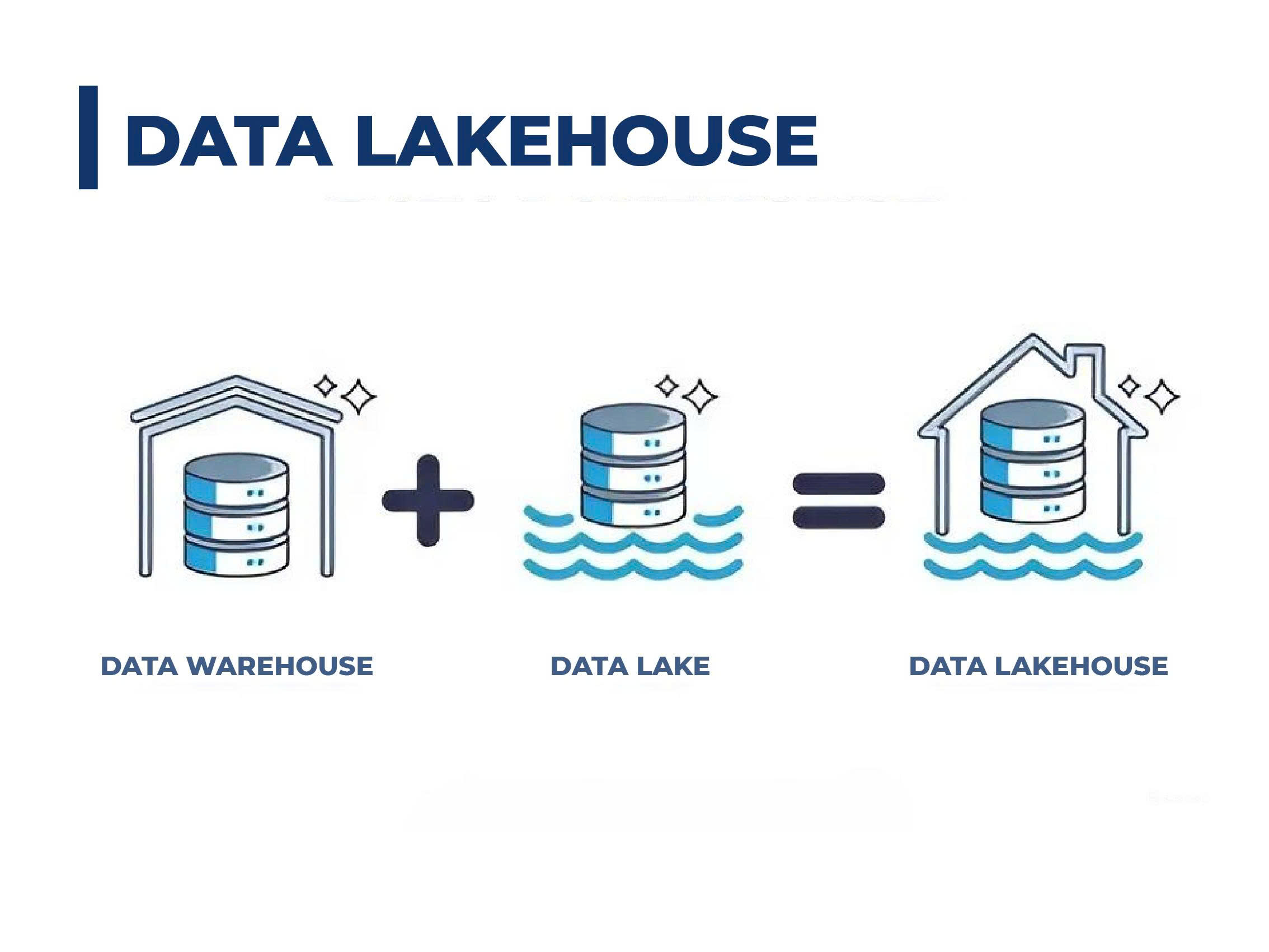
Until recently there were two separate options. A data lake can hold anything — structured and unstructured data alike — cheaply and flexibly, but it is disorderly and hard to query quickly. A data warehouse is tidy and fast to query for reporting, but rigid and expensive, and cannot hold raw data or the data AI needs.
A Data Lakehouse is the architecture that combines the strengths of both: the flexibility and low cost of the lake with the discipline and query speed of the warehouse — on a single copy of the data. There is no longer any copying between two systems.
A simple analogy
Think of a restaurant. A data lake is the cold store holding every raw ingredient — everything goes in, it is cheap and roomy, but guests cannot walk in and help themselves. A data warehouse is the display counter of finished dishes — attractive and ready to serve, but it holds very little. A lakehouse is a single continuous kitchen: raw ingredients, the preparation area and the serving counter all sit on one line, with no carrying food between two buildings.
How the data is organised
The Medallion model: Bronze → Silver → Gold
Inside the lakehouse, data is arranged in three layers of increasing quality — the kitchen line described above, named after bronze, silver and gold medals:
Bronze
Raw data
An unaltered copy from the source, with full history retained for audit. Nothing processed yet.
01
Silver
Standardised
Cleansed, de-duplicated, with keys and data types standardised and modelled to the business.
02
Gold
Ready to use
Business data marts optimised for BI and ML, holding KPIs and features ready for use.
03
A simple analogy
Bronze is the ingredient just delivered, with the invoice still attached for checking. Silver is washed, cut and measured to standard. Gold is the finished dish on the counter, served the moment it is ordered. Anyone who needs it ready to eat takes it from Gold; anyone wanting to create a new dish — deeper analysis, training a model — goes back to Silver or Bronze, with the original data still intact.
Because the three layers are clearly separated, every change can be traced to its source, and if an error is found in Gold it can always be rebuilt from Bronze without any data loss.
The technical foundation
Open storage: avoiding vendor lock-in
What makes a lakehouse durable is open storage: data sits on object storage (S3, MinIO, Ceph) in the open table format Apache Iceberg — supporting ACID transactions, time travel through history, and safe schema evolution.
Most importantly, Iceberg separates storage from compute. Different engines (Spark for large-scale processing, Flink for real-time streams, Trino for fast queries) all read the same copy of the data, rather than each tool holding its own.
A simple analogy
It is like separating the larder from the number of chefs. On a busy day you hire more chefs (add compute) without building another store room; on a quiet day the chefs go home and the store room remains. Vendor lock-in, by contrast, is like building a kitchen that only runs one manufacturer’s equipment — when one item fails, the whole kitchen has to be replaced. Open storage means you own your own data.
The result: scale independently as needed, optimise cost, and depend on no single vendor.
The extension strategy
Start with an ODS — on the lakehouse itself
An ODS (operational data store — a consolidated operational data layer) is the practical starting point: it brings operational data together in near real time to support a 360° customer view, transaction reconciliation and intraday reporting.
What distinguishes the DBIZ approach: the ODS is built directly on the lakehouse (Iceberg plus object storage) rather than on a traditional database that would later have to be migrated. The ODS is simply phase one of the lakehouse — the same technology, a narrower scope.
Why this matters
Build once, use indefinitely. An ODS on a traditional database is a dead end — moving to a lakehouse means rebuilding. On Iceberg you simply add layers: extend the sources, bring unstructured data into Bronze, standardise through Medallion, then add BI, ML and AI agents — all on one foundation, with the original investment preserved.
The destination
From data to Agentic AI
A unified, clean and governed data foundation is the precondition for AI entering real operations rather than stopping at a pilot. The DBIZ Autonomous layer builds and operates the AI agents: a system that can take an objective, plan its own approach, call tools and data, decide and then act — always within the enterprise’s framework of control.
Agents draw directly on the Gold layer for business use, and use RAG (retrieval-augmented generation) over vector data to answer accurately from internal documents, rather than inferring without evidence.
Control accompanies capability
The more autonomy, the more guardrails are required. The accompanying mechanisms include human-in-the-loop (a person approves risky actions), guardrails against prompt injection, filtering of personal data (PII), permissioned actions, and an audit log recording every step for monitoring and assessment.
This is why the value of an AI platform lies not in “the clever AI” but in the quality of the data and the strength of the controls around it.
Security
Security & compliance throughout
Data governance is not a later step — it is a foundation layer running through every tier. Data is encrypted at rest and in transit; permissions apply down to the individual column and row (column- and row-level security); sensitive data is masked or tokenised; and every access is logged for audit.
Decree 13/2023Personal data protection: classification, consent and the rights of the data subject.
ISO 27001Information security management: control, assessment and treatment of risk.
PCI DSSPayment card data security in storage, processing and transmission.
Lineage & auditComplete data lineage, with the ability to reproduce reports for investigation.
Delivery
A phased roadmap
What experience shows: begin with a use case of clear value, deliver layer by layer rather than big-bang, and build governance in from day one. A typical roadmap:
Phase 1
0–3 months
Foundation & PoC
Build the lakehouse infrastructure
Integrate one or two core sources
PoC on the priority use case
Phase 2
3–6 months
ODS & BI
Complete the ODS
Business BI dashboards
Governance & security
Phase 3
6–12 months
Lakehouse & AI/ML
Extend Medallion
An MLOps platform
Self-service BI
Phase 4
12+ months
Autonomous AI
Deploy AI agents
Agentic AI in the business
Optimise & extend
This structure lets an enterprise prove value early, keep risk under control, and build each phase on what the previous one delivered.
Let us start with a PoC
The fastest way to evaluate this is a contained trial: a separate environment, anonymised data, and a complete demonstration from ingestion → Iceberg storage → processing → BI/AI consumption in six to eight weeks, with measurable results.
The Autonomous Enterprise: when a business runs itself
Enterprises are no longer simply “using software to work faster”. The next step is for the system to observe, decide and act on its own in the work that repeats — so people concentrate only on what genuinely matters. This is the Autonomous Enterprise .
1.The real problem: businesses are busy rather than effective
Picture a coffee chain with 20 outlets. Every morning, one member of staff has to:
Open each inventory report to see which outlet is running low on milk or cups.
Call or message suppliers to place the top-up orders.
Reconcile invoices and enter the figures into the books.
None of this is difficult, but it consumes the whole morning and is easy to get wrong. Miss one outlet and it runs out that day, and the revenue is lost. This is the bottleneck in most businesses: people doing work a machine could handle entirely.
The question is not “how do we do this faster”, but “which of these tasks no longer needs a person at all?”
2.Three stages: from manual work to self-operation
To understand the Autonomous Enterprise, consider three stages of evolution:
Stage
Name
What it is
In the coffee chain
1
Manual (manual)
People do everything
Staff check stock and place orders themselves
2
Automation (automation)
The machine follows fixed rules
“When stock falls below 10, send a reminder email”
3
Autonomous (autonomous)
The machine observes, reasons and acts
The system forecasts weekend demand, orders the right quantity and reconciles the invoices itself
The essential difference between stage 2 and stage 3:
Automation only does what you programmed in advance. Faced with something new, it stops.
Autonomy rests on an AI agent — a programme that makes its own decisions within the remit it has been given. It looks at the data, understands the context and acts: more like delegating to a capable colleague than installing a machine that presses a button.
An Autonomous Enterprise is what emerges when many AI agents work together across different business areas, so the organisation largely runs itself.
3.DBIZ Autonomous: bringing the idea into Vietnamese practice
The theory is easy; delivering it in a Vietnamese enterprise is the hard part. This is what DBIZ set out to solve with DBIZ Autonomous — an ecosystem of 97 AI agents designed for specific business functions.
The 97 agents are organised into nine groups, each covering one area:
Sales & marketing (13): sales forecasting, lead scoring, price optimisation.
Customer experience (11): a 24/7 chatbot, customer sentiment analysis.
Data governance & analytics (27): data quality control, report generation, trend forecasting, a 360° view of the customer.
Integration & automation (9): connecting systems, document processing, API management.
General & other (12): churn prediction, next-best-action recommendations, audit logging.
Back to the coffee chain: instead of one person doing everything each morning, StockBot handles inventory, DemandPro forecasts weekend demand, InvoiceBot processes the invoices and ChatBot247 answers customers around the clock. People move to the work that genuinely requires judgement: opening new outlets, designing new drinks, looking after key customers.
4.The decisive difference: running on your own infrastructure
Most AI solutions today are cloud-based — running on a foreign provider’s servers. Convenient, but carrying three significant risks for a Vietnamese enterprise:
Data leaves the company. Every invoice, customer list and product formulation is sent outside.
Costs float. Billing is by usage (API cost) — the more you use it the more you pay, and budgeting is difficult.
Dependency. If the provider changes its policy, raises prices, or the connection drops, the work stops.
DBIZ Autonomous takes the opposite approach — on-premise , running on the enterprise’s own servers:
Criterion
DBIZ Autonomous
A typical cloud AI solution
Data
Stays 100% internal
Sent outside
Cost
Fixed and controllable
Floats with usage
Works without connectivity
Keeps running (offline)
Stops
Customisability
Fully adapted to your processes
Limited
A simple analogy: using the cloud is like renting a kitchen elsewhere — convenient, but your signature recipe is visible to everyone, and the owner can raise the rent whenever they choose. On-premise is like having the kitchen in your own building — the recipe stays yours, and you know exactly what it costs each month.
5.Measurable benefits, not promises
Based on the figures DBIZ publishes and results from actual customers:
60–80%Reduction in manual processing time
~40%Increase in productivity
6–12 monthsReturn on investment
2–4 weeksFrom deployment to go-live
ROI: return on investment — how long before the investment earns back its cost.
Some of the results DBIZ has demonstrated in practice:
PVOIL
Petroleum · 900 storesNetwork-wide inventory management and improved efficiency 42%.
LeePak
Manufacturing and exportSavings in 28% time and cost.
Hoang Gia Holding
Real estateAutomation of the sales network, with a reduction in 35% costs.
6.Where to begin? Do not try to automate everything at once
The common mistake is wanting to automate the whole organisation immediately. The right approach is to choose one clear pain point, deliver a result, then extend. The roadmap DBIZ proposes fits into three to four weeks:
Weeks 1–2 — Assessment: analysing current processes and selecting the right group of agents to start with.
Weeks 2–3 — Installation: building the internal infrastructure and integrating with the existing ERP.
Weeks 3–4 — Go-live: user training, user acceptance testing (UAT), then formal operation.
From month 2 — Extension: adding new agents and rolling out across the organisation.
A practical recommendation: choose the task that repeats most often and consumes the most people as the pilot — invoice processing, or customer chat coverage. Once the result is clear, extend to other areas. This carries less risk, is easier to make the case for internally, and lets you measure the effect at every step.
In closing: the Autonomous Enterprise is not a distant future
Self-operation does not mean replacing people; it means returning people to their proper role — thinking, creating and making the significant decisions — and handing the repetitive work to AI agents.
With 18 years of experience, more than 100 customers and an ecosystem of 97 AI agents running on your own infrastructure, DBIZ is turning the Autonomous Enterprise from a trend into a concrete step that can be taken in a matter of weeks by Vietnamese enterprises.
The question is no longer “should we”, but “which task do we start with”.
The percentages above are industry reference levels — the range of impact international research bodies have recorded where organisations automate processes with AI: McKinsey Global Institute (2017) estimates that around half of today’s work activities are technically automatable; McKinsey & Company (2018) assesses that 42% of finance activities can be fully automated and a further 19% mostly automated with currently demonstrated technology; Brynjolfsson, Li & Raymond — NBER (2023) found a generative AI assistant raised customer-support productivity by 14% on average, and by 34% among newer staff. These are not measurements taken at any specific organisation and are not a performance commitment; actual results vary with deployment scope, data readiness and the current state of each organisation’s operations. Figures DBIZ has measured in the field are published separately together with the measurement method — see AP Agent — figures measured in the field. DBIZ commits to specific targets for each client after the assessment phase.
Introduction: from “AI that answers” to “AI that works”
Most enterprises are familiar with AI in the form of a chatbot: you ask, it replies. Stopping there makes AI little more than a more capable reference tool.
Agentic AI — AI that decides and acts on a person’s behalf within a process — is a different proposition entirely. Rather than waiting for instruction at every step, each agent is given a specific business task: it gathers the data, analyses it, carries out the work and raises an alert when something is wrong.
A familiar example
A sales chatbot only answers “this product is in stock”. A smart order agent, by contrast, looks at the customer’s purchase history, anticipates what they will need next, drafts a proposed order and prompts a member of staff to approve it. One is a gatekeeper that can speak; the other is an assistant that can work.
This is the direction DBIZ — with more than 18 years delivering digital solutions to over 100 enterprises — is building into a full product ecosystem.
The overall picture: four pillars plus a device layer
The DBIZ ecosystem is not a single AI product but a set of products with AI agents built into each business area:
DBIZ ERP + AI Agent — enterprise-wide management (finance, inventory, production, HR). ERP (enterprise resource planning) is the backbone holding all operational data.
DBIZ CX + AI Agent — customer experience management, comprising 11 modules: CDP, sales forecasting, omni-channel selling, customer service, marketing automation and more.
DBIZ Data + AI Agent — intelligent data analysis, turning raw figures into insight that can be acted on.
DBIZ Autonomous — the command layer, bringing the 97 AI agents from all three pillars into one unified system.
Alongside these sit microSME (a compact package for small businesses), together with the IoT device layer and robotics — reaching the plant and the shop floor, not only office software.
The underlying logic
Data lives in the ERP and CDP → agents read that data to make decisions → the results are written back to the system. Agents are not a separate AI layer bolted on for appearance; they live within the operational data flow itself.
The heart of the ecosystem: DBIZ Autonomous — 97 AI agents
This is the product where the agentic character is clearest. DBIZ positions it as a complete AI agent ecosystem for the enterprise, with 97 agents organised into nine specialist groups, each covering one domain:
One neat detail in how DBIZ names its agents: the name tells you the agent’s level. The suffix Bot denotes basic automation (for example InvoiceBot for invoice processing); Pro denotes a professional level (CashFlowPro for cash-flow forecasting); Master denotes the senior level (AuditMaster for audit); the Scout / Guard / Watch family handles monitoring and alerting; and Optimizer / Wise agents specialise in optimisation. The name alone tells you whether the agent’s work is simple or complex.
The core difference: AI running on your own infrastructure
This is the most notable aspect, and a deliberate strategic choice by DBIZ. Most AI solutions today call out to an external cloud service (such as ChatGPT or Google AI) — meaning enterprise data must leave the organisation, and cost is billed by usage.
DBIZ Autonomous takes the opposite approach: it uses local models running on internal servers, deployed on-premise on the enterprise’s own infrastructure. In practice this means:
Data never leaves your system — which matters in sensitive sectors such as finance, healthcare and manufacturing.
No usage-based API fees — a fixed cost that is straightforward to budget for. DBIZ estimates that for 500 users a year, a cloud solution costs in the region of USD 45,000–60,000, whereas the on-premise model keeps the cost fixed.
It works offline — with no dependency on connectivity or an external provider.
In short: you trade the plug-and-play convenience of the cloud for control of your data and predictable cost. For many Vietnamese enterprises, that is a trade worth making.
Outcomes and the delivery roadmap
DBIZ cites expected outcomes of a 60–80% reduction in manual processing time, a productivity gain of around 40%, and a return on investment within 6–12 months.
Delivery is contained within roughly three to four weeks, in four straightforward steps:
Weeks 1–2 — Assessment: analysing current processes, selecting the right agents and designing the integration architecture.
Weeks 2–3 — Installation: building the internal infrastructure, integrating with the existing ERP and configuring the AI models.
Weeks 3–4 — Go-live: user training, user acceptance testing (UAT), then formal operation.
From month 2 — Extension: performance tuning, adding new agents and rolling out across the organisation.
This step-by-step approach reflects the nature of an ecosystem: there is no need to replace everything at once. Choose a few agents that address a real pain point, get them running reliably, then extend.
In closing: an ecosystem, not a set of isolated features
What gives this approach its value is not the figure of 97 agents, but the fact that they share one data foundation (ERP plus CDP) and one operating philosophy: run internally, and your data stays yours.
A single agent is only a utility. But when the sales forecasting agent can talk to the inventory optimisation agent, and that agent in turn connects to the production scheduling agent, the enterprise gains a digital workforce operating continuously behind the scenes, rather than a handful of disconnected smart features.
That is the difference between buying an AI tool and building an Agentic AI ecosystem — and it is the problem DBIZ is solving.