Category: Insights

  • Comparing the DBIZ product packages

    Comparing the DBIZ product packages

    Comparing the DBIZ product packages

    Contact us

    Finance & accounting management

    HR management

    Sales management

    Inventory management

    Production management

    Purchasing management

    Automated AI agents

    Analytical reporting

    Mobile app

    Multi-platform integration

    Contact us

    Advanced CRM

    Marketing automation

    Customer service

    Omni-channel support

    AI chatbot

    Analytics & reports

    Email marketing

    SMS campaigns

    Social media integration

    APIs & webhooks

    Contact us

    Data warehouse

    Business intelligence

    AI/ML analytics

    Custom dashboards

    Automated reporting

    Trend forecasting

    Data visualisation

    ETL pipeline

    Real-time analytics

    API integration

    Contact us

    Sales management

    Basic inventory management

    Customer management

    Basic reporting

    Mobile app

    10 GB cloud storage

    Detailed comparison table

    FeatureDBIZ ERPDBIZ CXDBIZ DatamicroSME
    Core features
    Customer management
    Sales management
    Inventory management
    Financial management
    HR management
    Advanced features
    Automated AI agents
    Machine learning
    Marketing automation
    Advanced analytics
    Predictive analytics
    Integration & APIs
    REST API
    Webhooks
    Third-party integration
    Custom integration
    Support
    Email support
    Telephone support
    Dedicated account manager
    On-site training
    24/7 support

    Large enterprises

    SMEs & startups

  • Product: DBIZ Deep Sales AI BDR

    Product: DBIZ Deep Sales AI BDR

    Deep Sales AI BDR

    Deep Sales AI BDR combines Agentic AI with the role of the BDR — business development representative . Deep Sales AI BDR should be understood as a system that fully automates the process of finding and approaching prospects.

    You act as the principal, simply issuing an instruction — for example: “Find me logistics companies in Vietnam and invite them to a product demonstration.” The AI BDR does the rest: it finds the companies, researches them, writes the content, sends the messages and books the meetings into your calendar.


    What is a BDR? (The human role)

    In a company, the BDR (business development representative) is responsible for the top of the funnel . Their day-to-day work involves:

    • Searching online to build a list of potential customers (leads)
    • Sending cold emails or making cold calls
    • With a single objective: securing a meeting to hand over to a senior salesperson (account executive)

    It is repetitive work, time-consuming, and dispiriting given the constant rejection.


    What is an AI BDR? (The automated equivalent)

    Deep Sales AI BDR is a virtual colleague that uses artificial intelligence to automate the entire role of a human BDR, at far greater scale and speed.

    Rather than employing a number of BDRs to do the work by hand, a business needs only one AI BDR operating continuously.


    What Deep Sales AI BDR can do

    1. Automated prospecting

    • Searches data sources for companies matching the criteria you set
    • Filters by country, company size, industry and the systems in use

    2. Deep research

    • Analyses each company’s website, LinkedIn presence and latest news
    • Uses real context to open the conversation

    3. Hyper-personalisation

    • Writes an individual email for each recipient, rather than using a generic template
    • Can generate accompanying imagery to raise the response rate

    4. Automated handling & booking

    • Reads and understands the customer’s reply
    • Sends the appropriate documents or a meeting booking link

    Human BDR compared with AI BDR

    Human BDR

    • Works around eight hours a day
    • Limited output (~50 personalised emails a day)
    • Prone to burnout and to missed follow-ups
    • High cost (salary, bonus, insurance)

    AI BDR (Deep Sales)

    • Operates 24/7, sending in the recipient’s own time zone
    • Handles large volumes simultaneously (1,000+ personalised emails a day)
    • Never misses a follow-up, and keeps to schedule
    • Cost is a software fee, typically lower than a salary
  • Data Lakehouse: one data source for both BI and AI

    DBIZ · Data & AI Platform

    Data Lakehouse: one data source for both BI and AI

    Why enterprises need not choose between a data lake and a data warehouse — and how a unified platform opens the way for AI to enter real operations.

    DBIZ Team Data architecture ~8 minute read
    Data Lakehouse — a unified data platform for the AI era

    Most enterprises are not short of data — what they lack is one trustworthy source everyone can look at. Data sits scattered across the ERP, the CRM, sales channels and spreadsheets; every system holds its own copy and every department quotes a different figure. Come reporting time, IT runs an overnight ETL and the next morning everyone finally has yesterday’s numbers.

    The four pressures most commonly felt:

    Fragmented dataERP, CRM and digital channels sit apart; consolidation is difficult, reconciliation is slow, and duplicate copies proliferate.
    Slow reporting (T+1)Dependence on an overnight ETL, no real-time figures, and the business waiting on IT.
    Compliance pressureFinancial reporting, Decree 13 on personal data, and requirements for lineage and audit.
    AI demand everywhereForecasting, fraud prevention, personalisation, chatbots — all requiring a clean data foundation and disciplined MLOps.

    The traditional response is to stand up another data warehouse alongside and copy data back and forth. But the more copies there are, the more points of divergence. The problem is not that another store is needed; it is the need to consolidate onto one foundation that both reporting and AI draw on.

    The concept

    What is a Data Lakehouse?

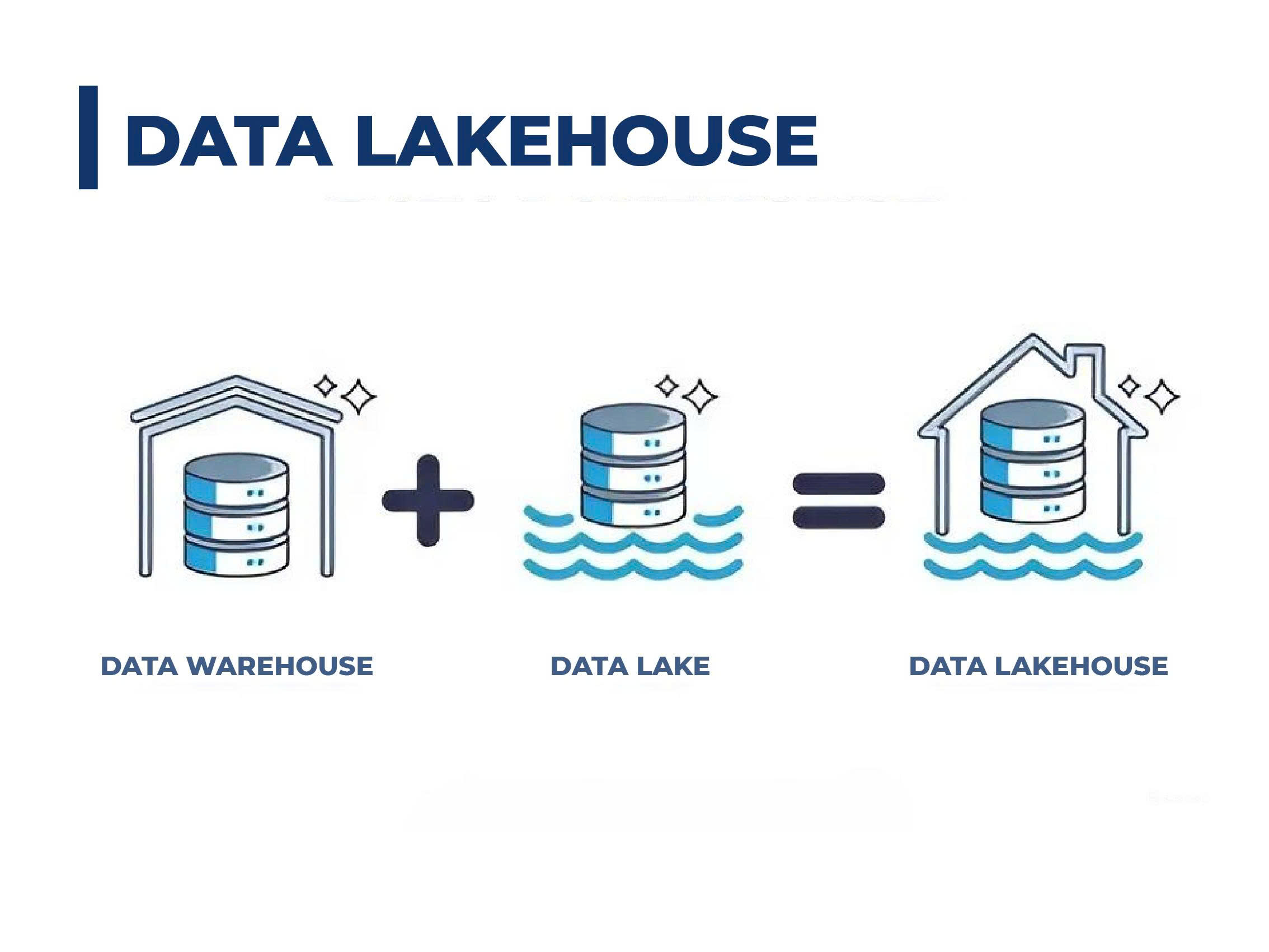
    Until recently there were two separate options. A data lake can hold anything — structured and unstructured data alike — cheaply and flexibly, but it is disorderly and hard to query quickly. A data warehouse is tidy and fast to query for reporting, but rigid and expensive, and cannot hold raw data or the data AI needs.

    A Data Lakehouse is the architecture that combines the strengths of both: the flexibility and low cost of the lake with the discipline and query speed of the warehouse — on a single copy of the data. There is no longer any copying between two systems.

    A simple analogy

    Think of a restaurant. A data lake is the cold store holding every raw ingredient — everything goes in, it is cheap and roomy, but guests cannot walk in and help themselves. A data warehouse is the display counter of finished dishes — attractive and ready to serve, but it holds very little. A lakehouse is a single continuous kitchen: raw ingredients, the preparation area and the serving counter all sit on one line, with no carrying food between two buildings.

    How the data is organised

    The Medallion model: Bronze → Silver → Gold

    Inside the lakehouse, data is arranged in three layers of increasing quality — the kitchen line described above, named after bronze, silver and gold medals:

    Bronze

    Raw data

    An unaltered copy from the source, with full history retained for audit. Nothing processed yet.

    01
    Silver

    Standardised

    Cleansed, de-duplicated, with keys and data types standardised and modelled to the business.

    02
    Gold

    Ready to use

    Business data marts optimised for BI and ML, holding KPIs and features ready for use.

    03
    A simple analogy

    Bronze is the ingredient just delivered, with the invoice still attached for checking. Silver is washed, cut and measured to standard. Gold is the finished dish on the counter, served the moment it is ordered. Anyone who needs it ready to eat takes it from Gold; anyone wanting to create a new dish — deeper analysis, training a model — goes back to Silver or Bronze, with the original data still intact.

    Because the three layers are clearly separated, every change can be traced to its source, and if an error is found in Gold it can always be rebuilt from Bronze without any data loss.

    The technical foundation

    Open storage: avoiding vendor lock-in

    What makes a lakehouse durable is open storage: data sits on object storage (S3, MinIO, Ceph) in the open table format Apache Iceberg — supporting ACID transactions, time travel through history, and safe schema evolution.

    Most importantly, Iceberg separates storage from compute. Different engines (Spark for large-scale processing, Flink for real-time streams, Trino for fast queries) all read the same copy of the data, rather than each tool holding its own.

    A simple analogy

    It is like separating the larder from the number of chefs. On a busy day you hire more chefs (add compute) without building another store room; on a quiet day the chefs go home and the store room remains. Vendor lock-in, by contrast, is like building a kitchen that only runs one manufacturer’s equipment — when one item fails, the whole kitchen has to be replaced. Open storage means you own your own data.

    The result: scale independently as needed, optimise cost, and depend on no single vendor.

    The extension strategy

    Start with an ODS — on the lakehouse itself

    An ODS (operational data store — a consolidated operational data layer) is the practical starting point: it brings operational data together in near real time to support a 360° customer view, transaction reconciliation and intraday reporting.

    What distinguishes the DBIZ approach: the ODS is built directly on the lakehouse (Iceberg plus object storage) rather than on a traditional database that would later have to be migrated. The ODS is simply phase one of the lakehouse — the same technology, a narrower scope.

    Why this matters

    Build once, use indefinitely. An ODS on a traditional database is a dead end — moving to a lakehouse means rebuilding. On Iceberg you simply add layers: extend the sources, bring unstructured data into Bronze, standardise through Medallion, then add BI, ML and AI agents — all on one foundation, with the original investment preserved.

    The destination

    From data to Agentic AI

    A unified, clean and governed data foundation is the precondition for AI entering real operations rather than stopping at a pilot. The DBIZ Autonomous layer builds and operates the AI agents: a system that can take an objective, plan its own approach, call tools and data, decide and then act — always within the enterprise’s framework of control.

    Agents draw directly on the Gold layer for business use, and use RAG (retrieval-augmented generation) over vector data to answer accurately from internal documents, rather than inferring without evidence.

    Control accompanies capability

    The more autonomy, the more guardrails are required. The accompanying mechanisms include human-in-the-loop (a person approves risky actions), guardrails against prompt injection, filtering of personal data (PII), permissioned actions, and an audit log recording every step for monitoring and assessment.

    This is why the value of an AI platform lies not in “the clever AI” but in the quality of the data and the strength of the controls around it.

    Security

    Security & compliance throughout

    Data governance is not a later step — it is a foundation layer running through every tier. Data is encrypted at rest and in transit; permissions apply down to the individual column and row (column- and row-level security); sensitive data is masked or tokenised; and every access is logged for audit.

    Personal Data Protection Law 91/2025Personal data protection: classification, consent and the rights of the data subject.
    ISO 27001Information security management: control, assessment and treatment of risk.
    PCI DSSPayment card data security in storage, processing and transmission.
    Lineage & auditComplete data lineage, with the ability to reproduce reports for investigation.
    Delivery

    A phased roadmap

    What experience shows: begin with a use case of clear value, deliver layer by layer rather than big-bang, and build governance in from day one. A typical roadmap:

    Phase 1
    0–3 months
    Foundation & PoC
    • Build the lakehouse infrastructure
    • Integrate one or two core sources
    • PoC on the priority use case
    Phase 2
    3–6 months
    ODS & BI
    • Complete the ODS
    • Business BI dashboards
    • Governance & security
    Phase 3
    6–12 months
    Lakehouse & AI/ML
    • Extend Medallion
    • An MLOps platform
    • Self-service BI
    Phase 4
    12+ months
    Autonomous AI
    • Deploy AI agents
    • Agentic AI in the business
    • Optimise & extend

    This structure lets an enterprise prove value early, keep risk under control, and build each phase on what the previous one delivered.

    Let us start with a PoC

    The fastest way to evaluate this is a contained trial: a separate environment, anonymised data, and a complete demonstration from ingestion → Iceberg storage → processing → BI/AI consumption in six to eight weeks, with measurable results.

    Talk to DBIZ
    Technical workshop
    Agree the use case and scope
    Prepare the data
    Identify sources, anonymise
    Run the PoC
    Deliver, evaluate and report
  • The Autonomous Enterprise: when a business runs itself

    DBIZ Autonomous

    The Autonomous Enterprise: when a business runs itself

    Enterprises are no longer simply “using software to work faster”. The next step is for the system to observe, decide and act on its own in the work that repeats — so people concentrate only on what genuinely matters. This is the Autonomous Enterprise .

    The Autonomous Enterprise — a business that runs itself

    1.The real problem: businesses are busy rather than effective

    Picture a coffee chain with 20 outlets. Every morning, one member of staff has to:

    • Open each inventory report to see which outlet is running low on milk or cups.
    • Call or message suppliers to place the top-up orders.
    • Reconcile invoices and enter the figures into the books.

    None of this is difficult, but it consumes the whole morning and is easy to get wrong. Miss one outlet and it runs out that day, and the revenue is lost. This is the bottleneck in most businesses: people doing work a machine could handle entirely.

    The question is not “how do we do this faster”, but “which of these tasks no longer needs a person at all?”

    2.Three stages: from manual work to self-operation

    To understand the Autonomous Enterprise, consider three stages of evolution:

    StageNameWhat it isIn the coffee chain
    1Manual (manual)People do everythingStaff check stock and place orders themselves
    2Automation (automation)The machine follows fixed rules“When stock falls below 10, send a reminder email”
    3Autonomous (autonomous)The machine observes, reasons and actsThe system forecasts weekend demand, orders the right quantity and reconciles the invoices itself

    The essential difference between stage 2 and stage 3:

    • Automation only does what you programmed in advance. Faced with something new, it stops.
    • Autonomy rests on an AI agent — a programme that makes its own decisions within the remit it has been given. It looks at the data, understands the context and acts: more like delegating to a capable colleague than installing a machine that presses a button.

    An Autonomous Enterprise is what emerges when many AI agents work together across different business areas, so the organisation largely runs itself.

    3.DBIZ Autonomous: bringing the idea into Vietnamese practice

    The theory is easy; delivering it in a Vietnamese enterprise is the hard part. This is what DBIZ set out to solve with DBIZ Autonomous — an ecosystem of 97 AI agents designed for specific business functions.

    The 97 agents are organised into nine groups, each covering one area:

    • Finance & accounting (12 agents): invoice processing, cash-flow forecasting, payment reconciliation, budget control.
    • Supply chain & logistics (11): inventory optimisation, demand forecasting, delivery route optimisation.
    • Production (6): production scheduling, preventive maintenance before a machine fails.
    • HR & payroll (7): CV screening, payroll calculation, performance assessment.
    • Sales & marketing (13): sales forecasting, lead scoring, price optimisation.
    • Customer experience (11): a 24/7 chatbot, customer sentiment analysis.
    • Data governance & analytics (27): data quality control, report generation, trend forecasting, a 360° view of the customer.
    • Integration & automation (9): connecting systems, document processing, API management.
    • General & other (12): churn prediction, next-best-action recommendations, audit logging.

    Back to the coffee chain: instead of one person doing everything each morning, StockBot handles inventory, DemandPro forecasts weekend demand, InvoiceBot processes the invoices and ChatBot247 answers customers around the clock. People move to the work that genuinely requires judgement: opening new outlets, designing new drinks, looking after key customers.

    4.The decisive difference: running on your own infrastructure

    Most AI solutions today are cloud-based — running on a foreign provider’s servers. Convenient, but carrying three significant risks for a Vietnamese enterprise:

    • Data leaves the company. Every invoice, customer list and product formulation is sent outside.
    • Costs float. Billing is by usage (API cost) — the more you use it the more you pay, and budgeting is difficult.
    • Dependency. If the provider changes its policy, raises prices, or the connection drops, the work stops.

    DBIZ Autonomous takes the opposite approach — on-premise, running on the enterprise’s own servers:

    CriterionDBIZ AutonomousA typical cloud AI solution
    DataStays 100% internalSent outside
    CostFixed and controllableFloats with usage
    Works without connectivityKeeps running (offline)Stops
    CustomisabilityFully adapted to your processesLimited
    A simple analogy: using the cloud is like renting a kitchen elsewhere — convenient, but your signature recipe is visible to everyone, and the owner can raise the rent whenever they choose. On-premise is like having the kitchen in your own building — the recipe stays yours, and you know exactly what it costs each month.

    5.Measurable benefits, not promises

    Based on the figures DBIZ publishes and results from actual customers:

    60–80%Reduction in manual processing time
    ~40%Increase in productivity
    6–12 monthsReturn on investment
    2–4 weeksFrom deployment to go-live

    ROI: return on investment — how long before the investment earns back its cost.

    Some of the results DBIZ has demonstrated in practice:

    PVOIL
    Petroleum · 900 storesNetwork-wide inventory management and improved efficiency 42%.
    LeePak
    Manufacturing and exportSavings in 28% time and cost.
    Hoang Gia Holding
    Real estateAutomation of the sales network, with a reduction in 35% costs.

    6.Where to begin? Do not try to automate everything at once

    The common mistake is wanting to automate the whole organisation immediately. The right approach is to choose one clear pain point, deliver a result, then extend. The roadmap DBIZ proposes fits into three to four weeks:

    • Weeks 1–2 — Assessment: analysing current processes and selecting the right group of agents to start with.
    • Weeks 2–3 — Installation: building the internal infrastructure and integrating with the existing ERP.
    • Weeks 3–4 — Go-live: user training, user acceptance testing (UAT), then formal operation.
    • From month 2 — Extension: adding new agents and rolling out across the organisation.
    A practical recommendation: choose the task that repeats most often and consumes the most people as the pilot — invoice processing, or customer chat coverage. Once the result is clear, extend to other areas. This carries less risk, is easier to make the case for internally, and lets you measure the effect at every step.

    In closing: the Autonomous Enterprise is not a distant future

    Self-operation does not mean replacing people; it means returning people to their proper role — thinking, creating and making the significant decisions — and handing the repetitive work to AI agents.

    With 18 years of experience, more than 100 customers and an ecosystem of 97 AI agents running on your own infrastructure, DBIZ is turning the Autonomous Enterprise from a trend into a concrete step that can be taken in a matter of weeks by Vietnamese enterprises.

    The question is no longer “should we”, but “which task do we start with”.

    Explore DBIZ Autonomous →
    Find out more at dbiz.com/san-pham-autonomous-en or request a demo to see the 97 AI agents in live operation.

    About the figures on this page

    The percentages above are industry reference levels — the range of impact international research bodies have recorded where organisations automate processes with AI: McKinsey Global Institute (2017) estimates that around half of today’s work activities are technically automatable; McKinsey & Company (2018) assesses that 42% of finance activities can be fully automated and a further 19% mostly automated with currently demonstrated technology; Brynjolfsson, Li & Raymond — NBER (2023) found a generative AI assistant raised customer-support productivity by 14% on average, and by 34% among newer staff. These are not measurements taken at any specific organisation and are not a performance commitment; actual results vary with deployment scope, data readiness and the current state of each organisation’s operations. Figures DBIZ has measured in the field are published separately together with the measurement method — see AP Agent — figures measured in the field. DBIZ commits to specific targets for each client after the assessment phase.

  • The DBIZ Agentic AI product ecosystem

    Agentic AI · The product ecosystem

    The DBIZ Agentic AI product ecosystem

    The DBIZ Agentic AI product ecosystem

    Introduction: from “AI that answers” to “AI that works”

    Most enterprises are familiar with AI in the form of a chatbot: you ask, it replies. Stopping there makes AI little more than a more capable reference tool.

    Agentic AI — AI that decides and acts on a person’s behalf within a process — is a different proposition entirely. Rather than waiting for instruction at every step, each agent is given a specific business task: it gathers the data, analyses it, carries out the work and raises an alert when something is wrong.

    A familiar example

    A sales chatbot only answers “this product is in stock”. A smart order agent, by contrast, looks at the customer’s purchase history, anticipates what they will need next, drafts a proposed order and prompts a member of staff to approve it. One is a gatekeeper that can speak; the other is an assistant that can work.

    This is the direction DBIZ — with more than 18 years delivering digital solutions to over 100 enterprises — is building into a full product ecosystem.

    The overall picture: four pillars plus a device layer

    The DBIZ ecosystem is not a single AI product but a set of products with AI agents built into each business area:

    • DBIZ ERP + AI Agent — enterprise-wide management (finance, inventory, production, HR). ERP (enterprise resource planning) is the backbone holding all operational data.
    • DBIZ CX + AI Agent — customer experience management, comprising 11 modules: CDP, sales forecasting, omni-channel selling, customer service, marketing automation and more.
    • DBIZ Data + AI Agent — intelligent data analysis, turning raw figures into insight that can be acted on.
    • DBIZ Autonomous — the command layer, bringing the 97 AI agents from all three pillars into one unified system.

    Alongside these sit microSME (a compact package for small businesses), together with the IoT device layer and robotics — reaching the plant and the shop floor, not only office software.

    The underlying logic

    Data lives in the ERP and CDP → agents read that data to make decisions → the results are written back to the system. Agents are not a separate AI layer bolted on for appearance; they live within the operational data flow itself.

    The heart of the ecosystem: DBIZ Autonomous — 97 AI agents

    This is the product where the agentic character is clearest. DBIZ positions it as a complete AI agent ecosystem for the enterprise, with 97 agents organised into nine specialist groups, each covering one domain:

    Business areaAgentsWhat the agents do (examples)
    Finance & accounting12Invoice processing, cash-flow forecasting, payment reconciliation
    Supply chain & logistics11Inventory optimisation, supplier assessment, delivery route optimisation
    Production (MES/APS)6Production scheduling, preventive maintenance, OEE optimisation
    HR & payroll7CV screening, payroll calculation, performance assessment
    Sales & marketing13Sales forecasting, lead scoring, price optimisation
    Customer experience (CX)1124/7 chatbot, sentiment analysis, churn prediction
    Data governance & analytics27Data quality control, predictive analysis
    Integration & automation9Data synchronisation, API monitoring
    General & other12Access control, audit logging, regulatory updates

    One neat detail in how DBIZ names its agents: the name tells you the agent’s level. The suffix Bot denotes basic automation (for example InvoiceBot for invoice processing); Pro denotes a professional level (CashFlowPro for cash-flow forecasting); Master denotes the senior level (AuditMaster for audit); the Scout / Guard / Watch family handles monitoring and alerting; and Optimizer / Wise agents specialise in optimisation. The name alone tells you whether the agent’s work is simple or complex.

    The core difference: AI running on your own infrastructure

    This is the most notable aspect, and a deliberate strategic choice by DBIZ. Most AI solutions today call out to an external cloud service (such as ChatGPT or Google AI) — meaning enterprise data must leave the organisation, and cost is billed by usage.

    DBIZ Autonomous takes the opposite approach: it uses local models running on internal servers, deployed on-premise on the enterprise’s own infrastructure. In practice this means:

    • Data never leaves your system — which matters in sensitive sectors such as finance, healthcare and manufacturing.
    • No usage-based API fees — a fixed cost that is straightforward to budget for. DBIZ estimates that for 500 users a year, a cloud solution costs in the region of USD 45,000–60,000, whereas the on-premise model keeps the cost fixed.
    • It works offline — with no dependency on connectivity or an external provider.

    In short: you trade the plug-and-play convenience of the cloud for control of your data and predictable cost. For many Vietnamese enterprises, that is a trade worth making.

    Outcomes and the delivery roadmap

    DBIZ cites expected outcomes of a 60–80% reduction in manual processing time, a productivity gain of around 40%, and a return on investment within 6–12 months.

    Delivery is contained within roughly three to four weeks, in four straightforward steps:

    1. Weeks 1–2 — Assessment: analysing current processes, selecting the right agents and designing the integration architecture.
    2. Weeks 2–3 — Installation: building the internal infrastructure, integrating with the existing ERP and configuring the AI models.
    3. Weeks 3–4 — Go-live: user training, user acceptance testing (UAT), then formal operation.
    4. From month 2 — Extension: performance tuning, adding new agents and rolling out across the organisation.

    This step-by-step approach reflects the nature of an ecosystem: there is no need to replace everything at once. Choose a few agents that address a real pain point, get them running reliably, then extend.

    In closing: an ecosystem, not a set of isolated features

    What gives this approach its value is not the figure of 97 agents, but the fact that they share one data foundation (ERP plus CDP) and one operating philosophy: run internally, and your data stays yours.

    A single agent is only a utility. But when the sales forecasting agent can talk to the inventory optimisation agent, and that agent in turn connects to the production scheduling agent, the enterprise gains a digital workforce operating continuously behind the scenes, rather than a handful of disconnected smart features.

    That is the difference between buying an AI tool and building an Agentic AI ecosystem — and it is the problem DBIZ is solving.

    Find out more and request a demo at dbiz.com.
  • DBIZ AP Agent — when invoice entry is no longer a burden on the finance team

    DBIZ Autonomous · AI Agent

    DBIZ AP Agent — when invoice entry is no longer a burden on the finance team

    DBIZ AP Agent — automating invoice processing for the finance team

    A problem every finance team knows

    At month end, an accounts payable clerk sits in front of hundreds of supplier invoices: some arrived by email, some on paper, some downloaded from the e-invoice portal. Their job is to key in every line by hand — supplier name, tax code, each line item, the amount, the VAT — into the accounting system, and then check whether the invoice is valid.

    The work is repetitive, among the most time-consuming in the finance function, and highly error-prone. A single mistyped figure can distort the payables balance, delay a payment, or create difficulty at tax finalisation.

    This is precisely the problem DBIZ AP Agent (full name: AP Invoice Processing — AP = accounts payable, amounts owed to suppliers) was built to solve.

    What is DBIZ AP Agent?

    In short, it is an AI agent — software that carries out an assigned process on its own — dedicated to processing incoming invoices automatically from the moment they arrive through to posting in the system.

    Unlike a chatbot that only answers questions, the AP Agent executes the entire business process itself: reading the invoice, understanding its content, verifying its validity and pushing clean data into the accounting software — in place of manual entry.

    It is one of five principal AI agent products from DBIZ, alongside DBIZ Forecast (sales forecasting), DBIZ APS (production scheduling), DBIZ MES (production execution) and Chatbot AI. All five belong to the DBIZ Autonomous.

    How the AP Agent works

    The AP Agent follows three steps — exactly the way a capable accountant would, only faster and without fatigue:

    1

    Collecting invoices from every source

    The agent receives invoices automatically from Outlook, Gmail, or by drag-and-drop upload. There is no longer any need to gather invoices in one place by hand.

    2

    Reading and extracting the data with AI

    This is the core. The agent combines OCR (optical character recognition — reading text from an image) with an LLM (large language model — AI that understands context the way a person does) to extract each field precisely: supplier, tax code, line items, unit price, amount and tax. Combining OCR with an LLM makes it possible to handle even awkwardly laid-out invoices that OCR alone would misread.

    3

    Verifying with the tax authority

    The agent integrates checks against the General Department of Taxation’s system, confirming the invoice is valid before it is posted — reducing the risk of accepting an incorrect or illegitimate invoice.

    The result: instead of keying in every invoice, the accountant only reviews the exceptions the agent flags. The human role shifts from data entry to control — far better use of their time.

    Why this matters

    The real value of the AP Agent is not that it “types faster”, but three things:

    • Time saved and errors reduced. It removes the repetitive manual entry step — the most laborious and error-prone part of the process.
    • Better control of payables and cash flow. When incoming invoice data is current and clean, the business knows exactly who it owes, how much, and when it falls due — instead of that information sitting trapped in a pile of unentered invoices.
    • Confidence on tax. Automatic verification against the tax authority keeps the input records clean from the outset, reducing risk at finalisation.

    The difference: AI running on your own infrastructure

    This is the notable part, and the philosophy running through DBIZ Autonomous. Invoices are sensitive financial data — no business wants every supplier invoice sent out to an external AI service.

    The AP Agent therefore follows a local AI approach: the AI model runs on the enterprise’s own infrastructure. In practice this means:

    • Data never leaves your system — meeting the security requirements of the finance function.
    • No per-call API fees — a fixed cost, with none of the “the more you use it, the more it costs” exposure of usage-billed cloud AI services.
    • No dependency on an external provider — the system keeps running even when the external connection is lost.

    Where it sits in the wider picture

    The AP Agent can be deployed on its own, but its real strength comes when it sits within the DBIZ ecosystem: incoming invoice data connects directly into ERP (enterprise resource planning) and the accounting software, then links to other agents such as payment reconciliation, cash-flow forecasting and budget control.

    At that point, invoice processing is no longer an isolated task someone has to shoulder at month end, but an automated link in the finance machine as a whole.

    In closing

    What DBIZ AP Agent does is straightforward: it takes the dullest and most error-prone work in accounting — entering and checking incoming invoices — and hands it to AI to do automatically and securely, on the enterprise’s own infrastructure.

    People are freed for work of greater value: analysis, control and decision-making. That is what a modern finance function actually needs.

    Find out more and request a demo at dbiz.com.
    Measured results

    AP Agent — figures measured in the field

    Operational assessment conducted in 2025 at a Vietnamese enterprise group with multiple legal entities, processing tens of thousands of invoices a year on an international ERP platform. The client is not named, under a confidentiality agreement.

    Measured baseline — before AP Agent

    • ~38 minutes of staff time to complete the full cycle for a single invoice, across 7 manual steps.
    • Labour cost of the full cycle: ~VND 132,000 per invoice, converted at that organisation’s own salary levels.
    • Cycle time from receiving an invoice to posting it in the ERP: ~9 days.
    • Actual data-entry rate: ~15 invoices per hour per person.
    • Preparing and approving a payment request alone: 3–5 days, signed by hand across several levels.
    • Capacity capped at ~1,900 working hours a year.

    Target operating levels with AP Agent

    • All 7 of 7 steps automated; staff move into a control and exception-handling role.
    • Invoice cycle time: from ~9 days to ~3 days.
    • Payment request preparation: from 5–10 minutes to 2–3 minutes.
    • Approval: from 3–5 days to within 8 hours, on mobile.
    • Printing and physical routing of documents eliminated entirely.
    • Operating 24/7/365 rather than within office hours only.

    Value not yet quantified

    The six items below were recorded during the assessment but not converted into figures. DBIZ proposes measuring them during deployment rather than attaching a number without a basis.

    Cost of errors and rework Early-payment discounts Document retrieval for audit Supplier risk control Absorbing growth without new hires Audit trail & Personal Data Protection Law 91/2025 compliance

    On methodology: the “measured baseline” figures are actual measurements, drawn from the client’s 2025 operational statistics and a step-by-step time study. The “target operating levels” are the levels DBIZ designs to and commits to re-measure jointly with the client during the pilot phase.

    On the cost figure: the ~VND 132,000 per invoice reflects the salary levels and operating structure of the organisation assessed; it is not an industry standard. DBIZ recalculates this figure from each client’s own data during the assessment phase.

    On intent: this is a capacity problem, not a headcount reduction exercise. Document volume exceeds what office hours can absorb, so the Agent takes on data entry and the finance team moves into control, analysis and exception handling.