
Data Lakehouse: one data source for both BI and AI
Why enterprises need not choose between a data lake and a data warehouse — and how a unified platform opens the way for AI to enter real operations.
Most enterprises are not short of data — what they lack is one trustworthy source everyone can look at. Data sits scattered across the ERP, the CRM, sales channels and spreadsheets; every system holds its own copy and every department quotes a different figure. Come reporting time, IT runs an overnight ETL and the next morning everyone finally has yesterday’s numbers.
The four pressures most commonly felt:
The traditional response is to stand up another data warehouse alongside and copy data back and forth. But the more copies there are, the more points of divergence. The problem is not that another store is needed; it is the need to consolidate onto one foundation that both reporting and AI draw on.
What is a Data Lakehouse?
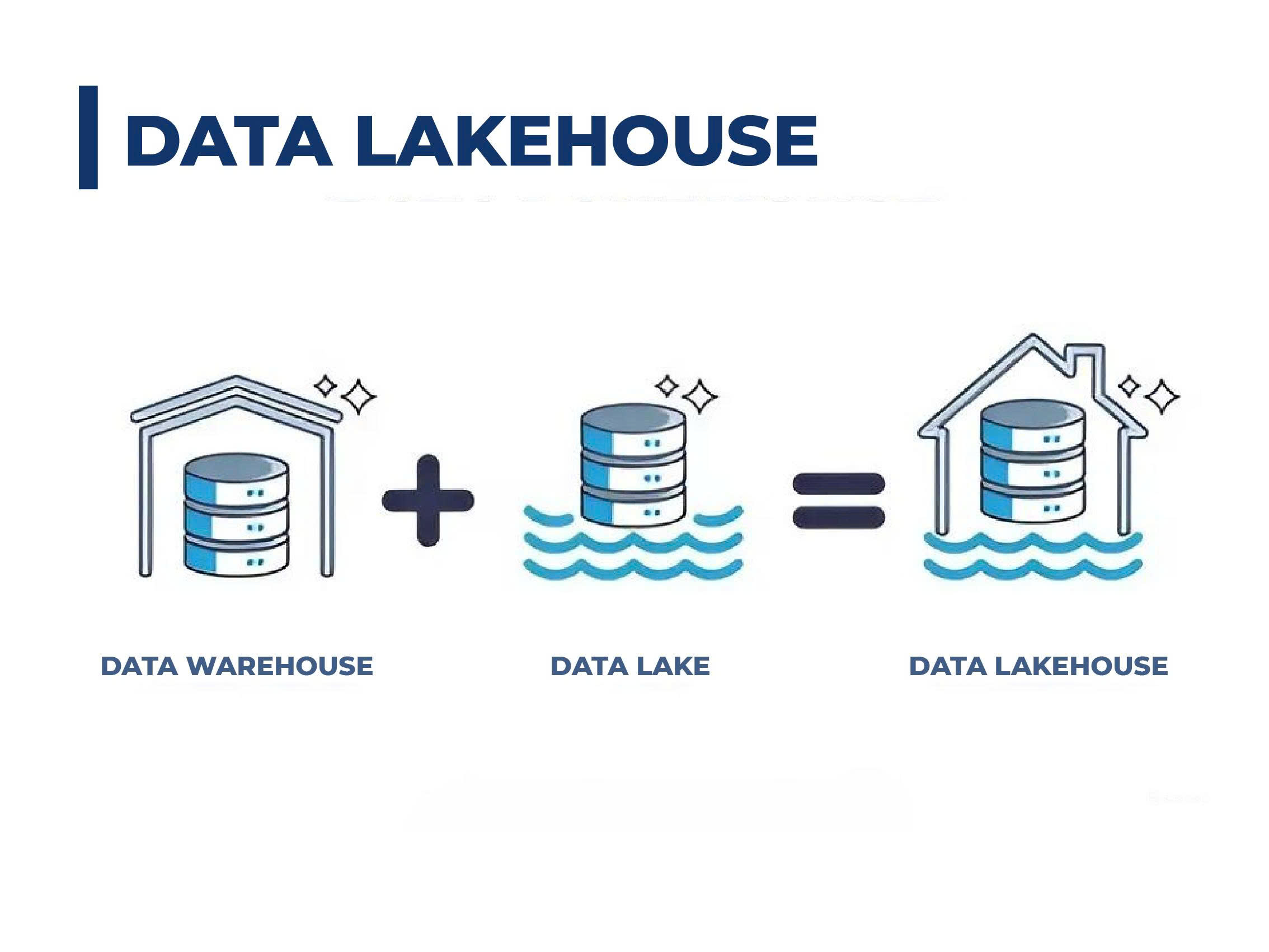
Until recently there were two separate options. A data lake can hold anything — structured and unstructured data alike — cheaply and flexibly, but it is disorderly and hard to query quickly. A data warehouse is tidy and fast to query for reporting, but rigid and expensive, and cannot hold raw data or the data AI needs.
A Data Lakehouse is the architecture that combines the strengths of both: the flexibility and low cost of the lake with the discipline and query speed of the warehouse — on a single copy of the data. There is no longer any copying between two systems.
Think of a restaurant. A data lake is the cold store holding every raw ingredient — everything goes in, it is cheap and roomy, but guests cannot walk in and help themselves. A data warehouse is the display counter of finished dishes — attractive and ready to serve, but it holds very little. A lakehouse is a single continuous kitchen: raw ingredients, the preparation area and the serving counter all sit on one line, with no carrying food between two buildings.
The Medallion model: Bronze → Silver → Gold
Inside the lakehouse, data is arranged in three layers of increasing quality — the kitchen line described above, named after bronze, silver and gold medals:
Raw data
An unaltered copy from the source, with full history retained for audit. Nothing processed yet.
01Standardised
Cleansed, de-duplicated, with keys and data types standardised and modelled to the business.
02Ready to use
Business data marts optimised for BI and ML, holding KPIs and features ready for use.
03Bronze is the ingredient just delivered, with the invoice still attached for checking. Silver is washed, cut and measured to standard. Gold is the finished dish on the counter, served the moment it is ordered. Anyone who needs it ready to eat takes it from Gold; anyone wanting to create a new dish — deeper analysis, training a model — goes back to Silver or Bronze, with the original data still intact.
Because the three layers are clearly separated, every change can be traced to its source, and if an error is found in Gold it can always be rebuilt from Bronze without any data loss.
Open storage: avoiding vendor lock-in
What makes a lakehouse durable is open storage: data sits on object storage (S3, MinIO, Ceph) in the open table format Apache Iceberg — supporting ACID transactions, time travel through history, and safe schema evolution.
Most importantly, Iceberg separates storage from compute. Different engines (Spark for large-scale processing, Flink for real-time streams, Trino for fast queries) all read the same copy of the data, rather than each tool holding its own.
It is like separating the larder from the number of chefs. On a busy day you hire more chefs (add compute) without building another store room; on a quiet day the chefs go home and the store room remains. Vendor lock-in, by contrast, is like building a kitchen that only runs one manufacturer’s equipment — when one item fails, the whole kitchen has to be replaced. Open storage means you own your own data.
The result: scale independently as needed, optimise cost, and depend on no single vendor.
Start with an ODS — on the lakehouse itself
An ODS (operational data store — a consolidated operational data layer) is the practical starting point: it brings operational data together in near real time to support a 360° customer view, transaction reconciliation and intraday reporting.
What distinguishes the DBIZ approach: the ODS is built directly on the lakehouse (Iceberg plus object storage) rather than on a traditional database that would later have to be migrated. The ODS is simply phase one of the lakehouse — the same technology, a narrower scope.
Build once, use indefinitely. An ODS on a traditional database is a dead end — moving to a lakehouse means rebuilding. On Iceberg you simply add layers: extend the sources, bring unstructured data into Bronze, standardise through Medallion, then add BI, ML and AI agents — all on one foundation, with the original investment preserved.
From data to Agentic AI
A unified, clean and governed data foundation is the precondition for AI entering real operations rather than stopping at a pilot. The DBIZ Autonomous layer builds and operates the AI agents: a system that can take an objective, plan its own approach, call tools and data, decide and then act — always within the enterprise’s framework of control.
Agents draw directly on the Gold layer for business use, and use RAG (retrieval-augmented generation) over vector data to answer accurately from internal documents, rather than inferring without evidence.
Control accompanies capability
The more autonomy, the more guardrails are required. The accompanying mechanisms include human-in-the-loop (a person approves risky actions), guardrails against prompt injection, filtering of personal data (PII), permissioned actions, and an audit log recording every step for monitoring and assessment.
This is why the value of an AI platform lies not in “the clever AI” but in the quality of the data and the strength of the controls around it.
Security & compliance throughout
Data governance is not a later step — it is a foundation layer running through every tier. Data is encrypted at rest and in transit; permissions apply down to the individual column and row (column- and row-level security); sensitive data is masked or tokenised; and every access is logged for audit.
A phased roadmap
What experience shows: begin with a use case of clear value, deliver layer by layer rather than big-bang, and build governance in from day one. A typical roadmap:
- Build the lakehouse infrastructure
- Integrate one or two core sources
- PoC on the priority use case
- Complete the ODS
- Business BI dashboards
- Governance & security
- Extend Medallion
- An MLOps platform
- Self-service BI
- Deploy AI agents
- Agentic AI in the business
- Optimise & extend
This structure lets an enterprise prove value early, keep risk under control, and build each phase on what the previous one delivered.
Let us start with a PoC
The fastest way to evaluate this is a contained trial: a separate environment, anonymised data, and a complete demonstration from ingestion → Iceberg storage → processing → BI/AI consumption in six to eight weeks, with measurable results.
Talk to DBIZAgree the use case and scope Prepare the data
Identify sources, anonymise Run the PoC
Deliver, evaluate and report